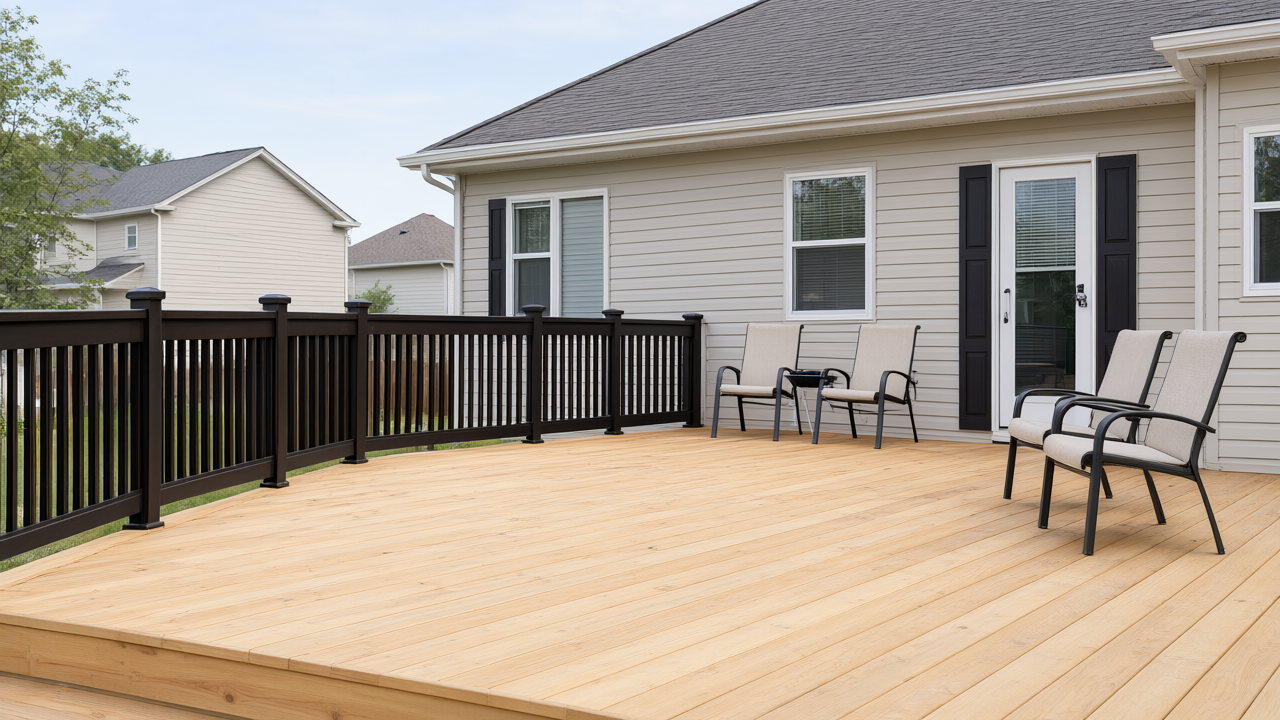
If you are comparing wood vs composite decking for your home in 2026, you have likely noticed that the sticker price for composite is roughly double that of pressure treated lumber. It is an easy reason to walk away from the showroom. But that upfront number is a trap. Over a 10 year lifecycle, the cost gap nearly vanishes, and in many cases composite ends up cheaper. The real financial question is not what the deck costs on day one, but what it costs you per year of actual service, and that is exactly what this lifecycle cost guide breaks down for Cary homeowners.
Why Lifecycle Cost Beats Upfront Price
The average homeowner in McHenry County makes a deck decision based on the quote they receive in the spring. They see $18,000 for a composite build versus $9,500 for a comparable wood structure and assume the wood deck is the smarter financial move. That math ignores the fact that a wood deck is not a finished product. It is a raw material that begins deteriorating the moment the last screw is driven.
Lifecycle cost accounting changes the conversation because it forces you to spread the total expense over the realistic lifespan of the material. A well built pressure treated deck in Cary will last 10 to 12 years if you stay on top of maintenance. A quality composite deck from a brand like Trex or TimberTech routinely delivers 25 to 30 years of service. When you divide the total cost of ownership by the years of use, the numbers flip.
Consider the cost per year of service. A $9,500 wood deck that lasts 10 years costs you $950 per year just in construction. A $18,000 composite deck that lasts 25 years costs you $720 per year. That is a 24% savings before you even factor in the cost of stain, sealant, replacement boards, and your own labor hours. The long game wins, and it wins clearly.

10-Year Cost Breakdown: Wood vs. Composite
The 10 year window is the most honest comparison because it captures the full maintenance cycle of a wood deck. In Cary, a wood deck needs a full cleaning and sealing every 12 to 18 months. Skipping a year invites moisture penetration, which is the primary cause of warping, cracking, and fastener failure in Illinois weather.
Here is the realistic 10 year budget for a 400 square foot deck in the Cary area:
- Wood deck initial build: $9,500 to $12,000 depending on design complexity and lumber grade
- Stain and sealer every 18 months: $60 per application in materials, or roughly $350 to $450 per application if you hire it out
- Power washing and cleaning: $100 to $200 per year if you do it yourself, more if you rent equipment
- Board replacement and repairs: $500 to $1,500 over the decade for warped or splintered planks
- Total 10 year cost for wood: $14,500 to $18,000, and the deck is nearing the end of its useful life
Composite follows a different curve. The initial investment is higher, but the ongoing costs flatten out dramatically.
- Composite deck initial build: $18,000 to $24,000 for the same footprint with premium materials
- Annual cleaning: $50 to $100 for a mild soap and soft brush, or a dedicated composite cleaner
- Repairs: $0 to $300 over the decade for the rare damaged board
- Total 10 year cost for composite: $18,500 to $25,000, with 15 to 20 more years of life remaining
The composite deck costs more over 10 years, but it is also providing value for an additional 15 years past the wood deck's retirement. If you extend the comparison to 25 years, the wood deck requires a complete rebuild at year 12, putting its true 25 year cost at $28,000 to $36,000. Composite finishes the same period at its original cost. That is the lifecycle argument in its most direct form.
Maintenance Costs in Cary, IL's Climate
Your zip code determines your deck's fate. Cary sits in a freeze thaw zone where temperatures swing from 90 degrees in July to negative 10 degrees in January. That cycle is brutal on wood. Moisture from snow melt seeps into the grain, freezes, expands, and cracks the fibers. A deck built in Arizona will last 20 years with minimal care. The same deck in Cary will show signs of stress in year 3 if it is not sealed properly.
Composite materials were engineered for exactly this climate. The polymer shell resists moisture absorption, so freezing water has nothing to penetrate. The boards do not splinter, which matters for families with kids running barefoot in July. They also resist the mold and mildew growth that thrives in shaded areas of Illinois yards during our humid summers.
One maintenance item that surprises Cary homeowners is the dust and pollen factor. Our springs produce a heavy layer of tree pollen that settles into wood grain and becomes a dark, gritty film. On wood, this film accelerates decay and requires aggressive power washing. On composite, a hose and a soft brush handles it in 30 minutes. The annual maintenance hour count tells the story: Wood Decks demand 8 to 12 hours per year, Composite Decks demand 1 to 2 hours.
Winter is where the difference becomes most visible. Wood decks in Cary need a snow shovel with a plastic edge, never metal, to avoid gouging the surface and exposing fresh wood to moisture. Composite handles the same snow load with zero risk of gouging, and it does not require the annual pre winter sealant application that wood decks demand. That fall sealing ritual, which costs $100 in materials and a full weekend of labor, simply does not exist on the composite side.

Resale Value: Which Deck Pays You Back in 2026?
The National Association of Realtors consistently reports that a deck recoups between 65% and 75% of its cost at resale. That number holds true for both wood and composite in the Chicago suburbs, but the buyer psychology differs. A wood deck reads as a future project. A composite deck reads as a finished amenity.
When buyers in Arlington Heights or Naperville walk a listing with a wood deck, they immediately calculate the cost of staining it before they move in. Many subtract that expense from their offer. A composite deck triggers no such calculation. Buyers see it as maintenance free, which is a powerful psychological advantage in a competitive 2026 housing market where buyers are scrutinizing every dollar of deferred maintenance.
There is a nuance worth understanding. A high end wood deck built with cedar or Ipe can command a premium because of its natural beauty and warmth. These species resist decay better than pressure treated pine and carry a longer lifespan. But they also cost nearly as much as composite to install and still require periodic oiling or sealing. For the vast majority of Cary homeowners, composite offers the better resale story because it eliminates the buyer's biggest objection.
The appraisal angle matters too. Appraisers in McHenry County are trained to recognize composite as a permanent improvement, similar to a brick patio or a vinyl sided addition. It appraises at a higher percentage of its cost because the appraiser does not have to discount for wear and tear on the surface. A 5 year old wood deck looks 5 years old. A 5 year old composite deck looks nearly new, and that visual difference translates directly into appraised value.
Decision Matrix: Choose the Right Deck for Your Home
Wood is not the wrong choice for everyone, and a good contractor will tell you that honestly. If your budget is truly capped at $10,000 and you cannot stretch it, a pressure treated deck built with proper flashing and joist tape will serve you well for a decade. If you enjoy the ritual of staining and sealing, and you take pride in maintaining a natural wood surface, wood offers a warmth that composite cannot replicate.
Composite wins when you value your weekends, plan to stay in your home for more than 5 years, or want to avoid the splinters and maintenance that come with wood. It also wins decisively for decks over 14 inches off the ground, where the underside is exposed to moisture and pests. A low, ground level wood deck is a reasonable compromise. A raised wood deck in Cary is a maintenance commitment that most homeowners underestimate.
Here is a practical checklist to run through before you make the call:
- Set a realistic budget that includes 10 years of maintenance, not just the build quote
- Decide how many hours per year you actually want to spend on deck upkeep
- Consider your resale timeline: if you plan to move within 5 years, composite maximizes your return
- Look at the deck height: raised decks demand more durable materials
- Ask about the warranty: composite boards come with 25 to 50 year warranties, wood carries none
- Get a quote from Burns Carpentry for both the Essential Deck Package and the Preferred Composite Deck Package to see the real price difference in Cary
The one area where you should never cut corners is the framing. Whether you choose wood or composite decking, the underlying structure in Cary must be built with properly spaced joists, galvanized hardware, and flashing at the house connection. A rotten ledger board is the number one cause of deck failure in Illinois, and it happens regardless of the decking surface. A professional build from a licensed contractor protects that investment.
A wood deck costs less on day one. A composite deck costs less over the life of your home. The choice is about whether you are buying for this season or this decade.
Frequently Asked Questions
How much more does composite decking cost than wood in 2026?
Composite decking typically costs 60% to 100% more than pressure treated wood for the same deck size. A 400 square foot wood deck runs $9,500 to $12,000, while composite runs $18,000 to $24,000. The gap narrows significantly when you factor in the 10 year maintenance costs and the composite deck's longer lifespan.
Is composite decking worth it for resale value?
Yes, most real estate agents in the Chicago suburbs report that composite decks are a stronger selling point than wood. Buyers view composite as maintenance free, which removes a future expense from their mental math. Composite decks also appraise higher because they retain their appearance for years longer than wood.
Does composite decking get too hot to walk on in the summer?
Darker composite colors can absorb heat and become uncomfortable on bare feet in direct July sun. Lighter tones and brands with heat reflective technology stay cooler. If you plan to walk barefoot, choose a lighter color or add a shade structure like a pergola to keep the surface temperature down.
What is the lifespan of a wood deck versus a composite deck in Illinois?
A pressure treated wood deck in Cary lasts 10 to 12 years with regular sealing and maintenance. A composite deck from a quality manufacturer lasts 25 to 30 years with minimal care. The freeze thaw cycle in Illinois shortens wood's lifespan significantly compared to warmer climates.
If you are ready to build a deck that matches your budget and your lifestyle, call Burns Carpentry in Cary. We build both the Essential Deck Package for wood and the Preferred Composite Deck Package, and we will give you a straight answer about which one makes sense for your home. We handle the permits, the framing, and the installation, so your only job is deciding how you want to spend your weekends for the next 25 years. Give us a call for a free estimate.