Most homeowners in Cary, IL assume that installing Vinyl Flooring means ripping out every layer of old carpet, tile, or hardwood before a single plank goes down. That assumption costs them between $1,800 and $4,500 in unnecessary demolition and dumpster fees on a typical 400 square foot room. Here's the truth that flooring contractors don't always volunteer: vinyl flooring can often be installed directly over existing hard surfaces, provided the subfloor passes three specific tests. The catch is knowing exactly when you can skip the tear-out and when skipping it will destroy your new floor within 18 months. This guide walks through the removal decisions Cary homeowners face in 2026, straight from the job sites.
When You Can Install Vinyl Flooring Over Existing Floors in Cary, IL
Vinyl plank and luxury vinyl tile (LVT) are floating or glue-down products, which means they depend entirely on what's underneath them for stability. A floating vinyl floor over a flat, sound substrate will last 20 years or more. The same floor over a spongy or uneven base will show every flaw through the surface within one heating season.
So when can you go over the top? There are three scenarios where skipping removal genuinely makes sense. First, if you have a single layer of sheet vinyl or old vinyl tile that is fully adhered, flat, and free of curling edges. Second, if you have ceramic or porcelain tile that is firmly bonded with no cracked or hollow-sounding tiles. Third, if you have engineered hardwood or solid hardwood that is level, dry, and securely fastened to the subfloor.
If any of those conditions fail, you're pulling it up. The math is unforgiving. A hollow tile will eventually crack under the point load of a refrigerator or a heavy walker, and once that happens your vinyl above it will tear at the seam. Curling sheet vinyl creates a void, and voids turn into bubbles and ridges in the new floor. One failed installation costs more than three correct removals.
"If you can push a putty knife under an edge and it lifts more than a quarter inch, that layer has to go."
There's also a height consideration. Adding vinyl over an existing hard surface raises your floor by roughly 5/16 to 3/8 of an inch. That matters at doorways, at the base of your stairs, and anywhere a dishwasher or refrigerator slides into a cabinet cavity. Measure those clearances before you commit.
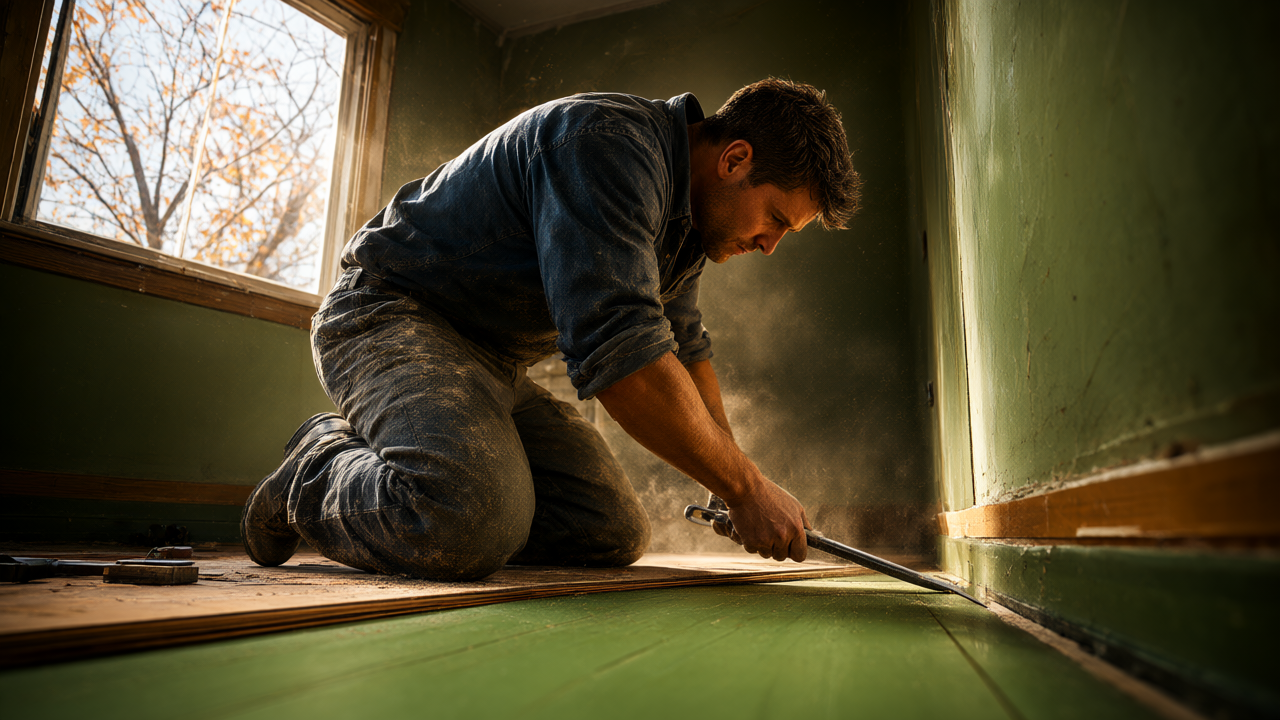
How to Remove Old Carpet, Tile, and Hardwood Before Vinyl Installation
Removal is the part of the job most homeowners underestimate. A 200 square foot bedroom with glued-down carpet and tack strip is a half-day project. A 400 square foot kitchen with mortar-set ceramic tile is a two to three day project and requires the right tools or you'll destroy the subfloor trying to get the tile up.
Here's the sequence that works, in order, for each material type:
- Carpet: Cut into 3 to 4 foot wide strips with a utility knife, roll each strip, and haul it out. Pull tack strip with a pry bar and a hammer. Remove staples with a flooring staple remover or a flat pry bar. Scrape any glued residue with a floor scraper, then sand the subfloor lightly with 60 grit paper.
- Ceramic or porcelain tile: Score the grout lines with a grout saw or an oscillating tool, then work a demolition hammer or a wide cold chisel under the tile edges. Rent a walk-behind tile stripper for anything over 200 square feet. Expect the thinset mortar to stay bonded. Grind it flat with a diamond cup wheel on an angle grinder, then vacuum thoroughly.
- Hardwood: Set a circular saw to the thickness of the boards and cut the floor into 2 by 3 foot sections. Pry each section up with a flat bar. Pull every staple and nail with a nail puller or a cat's paw. Fill the nail holes with wood filler only if you're leaving the subfloor exposed for more than a few days.
Budget for debris. A typical 300 square foot carpet removal produces three to five cubic yards of waste, which translates to a single dumpster rental of $350 to $550 in the Cary area. Tile and mortar removal is heavier and often requires a second dumpster.
One thing most homeowners don't realize: Burns Carpentry handles Flooring Installation as part of their broader carpentry work across Cary and the surrounding McHenry County area, which means they can also address the subfloor issues that removal exposes. That matters, because tearing out carpet often reveals problems the previous installer hid.
Subfloor Leveling and Repair: What Cary Homeowners Must Check First
Once the old floor is up, you're looking at the subfloor, and this is where vinyl installations live or die. Vinyl plank and LVT manufacturers typically require flatness within 1/8 inch over a 6 foot span or 3/16 inch over 10 feet. That's tighter than most people expect. A floor that feels perfectly flat underfoot can fail that test by a factor of three.
Get a 6 foot straightedge and a set of shims. Walk the room in a grid pattern, checking every 3 to 4 feet in both directions. Mark every high spot and low spot with chalk. High spots get ground down with a belt sander or a floor grinder. Low spots get filled with a self-leveling compound, which runs $30 to $45 per 50 pound bag and covers roughly 40 square feet at 1/8 inch depth.
Squeaks and soft spots are a separate problem. If the subfloor flexes when you walk on it, the vinyl will eventually crack along the flex line. Fix it before you install. From underneath, add blocking between the joists. From above, drive 2 inch deck screws every 6 to 8 inches along the joist lines and re-check. If you find water staining, rot, or delamination on the plywood or OSB, that section gets cut out and replaced with new 3/4 inch tongue and groove subfloor panels.
For concrete subfloors, which are common in Cary basements finished by Burns Carpentry, you're checking for cracks, spalling, and any sign of moisture migration. Hairline cracks are fine. Cracks wider than 1/8 inch, or any crack with vertical displacement, need to be filled with a flexible epoxy and monitored.

Moisture Testing Your Cary, IL Subfloor Before Vinyl Goes Down
Illinois climate is the enemy of vinyl flooring. Cary sits in McHenry County, where summer humidity regularly pushes indoor relative humidity above 60% and winter heating drops it below 25%. That swing causes subfloor materials to expand and contract. Vinyl, particularly the rigid core products, doesn't move much. When the subfloor moves and the vinyl doesn't, you get buckling, gapping, or adhesive failure.
Before any installation, test moisture. On a concrete slab, tape a 2 foot by 2 foot square of 6 mil plastic to the floor with all edges sealed, and leave it for 72 hours. If condensation forms under the plastic, or if the concrete underneath is visibly darker, you have a moisture problem that needs a vapor barrier or a moisture mitigation coating before vinyl goes down. On a wood subfloor, use a pin-type moisture meter. Wood subfloor moisture content should read within 4% of the installed vinyl's moisture content, and no higher than 12% in absolute terms. If it reads higher, run a dehumidifier in the room for 5 to 7 days and retest.
Acclimate your vinyl. This is the step homeowners skip and it's the single most common cause of installation failure in the Midwest. Bring the boxes into the room where they'll be installed and leave them for 48 to 72 hours at normal living temperature. In winter, that means 65 to 75 degrees. In summer, don't stack them in a hot garage and then install them the same day.
If you're installing in a Cary basement, pay extra attention. Basements here sit close to the water table in many neighborhoods, and moisture wicks up through concrete year round. Burns Carpentry's Basement Finishing work always starts with a moisture assessment for exactly this reason. If your basement has ever shown efflorescence (that white chalky powder on the concrete), you need a vapor barrier system, not just a moisture test.
5 Removal Mistakes That Ruin Vinyl Flooring Installations in Cary
These are the mistakes that show up on the callback list. Every one of them is preventable, and every one of them costs more to fix than to avoid.
- Leaving tack strip staples behind. A single missed staple will telegraph through a floating vinyl plank within weeks. Sweep the subfloor with a magnet, then run your bare hand across the entire surface. If you feel anything sharp, pull it.
- Not grinding thinset flat. After tile removal, the residual mortar creates a surface that looks flat but reads 1/4 inch out of plane over 6 feet. Vinyl over that surface will rock and click at the seams. Grind it, don't skim coat over it.
- Installing over a wet subfloor. This is the most expensive mistake. Trapped moisture turns into mold under the vinyl, and by the time you smell it, you're pulling up the entire floor and replacing the subfloor too. Test, wait, retest.
- Skipping acclimation in a rush. Vinyl installed straight from a cold truck in January will shrink as it warms, opening gaps at every seam. Acclimate for the full 48 to 72 hours.
- Removing load bearing or structural layers you didn't identify. Some older Cary homes have subfloors that are actually two layers of diagonal plank sheathing. Pulling the top layer because it looks like old hardwood can compromise the floor structure. If you're not sure what you're looking at, stop and get someone who is.
Here's where honesty matters: if you have a single layer of well bonded sheet vinyl in a small bathroom and the subfloor is dry and flat, you can absolutely do this yourself. A homeowner with basic tools can install 100 square feet of floating vinyl in a weekend. But if you're pulling up ceramic tile, dealing with a soft subfloor, or installing in a basement with any moisture history, the cost of doing it wrong is measured in thousands, not hundreds. Burns Carpentry provides vinyl flooring installation for homes across Cary and the surrounding area, and they handle the removal, subfloor prep, and leveling as one connected job, which is exactly how it should be scoped.
Frequently Asked Questions
Can you put vinyl flooring over tile in Cary, IL?
Yes, if the tile is firmly bonded, flat within 1/8 inch over 6 feet, and free of cracks or hollow spots. Grout lines will telegraph through thin vinyl, so use a rigid core plank at least 5mm thick or skim coat the grout lines first. If any tile sounds hollow when tapped, remove it.
How much does it cost to remove old flooring before installing vinyl in Cary?
Removal alone typically runs $1.50 to $3.50 per square foot depending on the material. Carpet is the cheapest to remove, ceramic tile the most expensive because of the mortar grinding. Add $350 to $550 for a dumpster in the Cary area. Full vinyl installation with removal and subfloor prep usually lands between $6 and $12 per square foot.
Do I need to remove baseboards before installing vinyl flooring?
You don't have to, but you should. Removing baseboards lets you install the vinyl with a proper expansion gap at the walls, and it lets you reinstall the baseboard on top of the new floor for a clean finished edge. Under-cutting the door jambs with an oscillating tool is the other option, and it's cleaner than trying to cut vinyl around them.
How long should vinyl flooring acclimate before installation in Illinois?
Plan on 48 to 72 hours in the room where it will be installed, at normal indoor temperature. Illinois winters make this non negotiable. Vinyl that goes down cold will expand once the room heats up, and that expansion has nowhere to go except into the seams.
If you're in Cary or anywhere in McHenry County and your project involves removing tile, fixing a soft subfloor, or installing vinyl in a basement, that's beyond a Saturday afternoon job. Burns Carpentry handles flooring installation, subfloor repair, and basement finishing as connected work, so nothing gets missed between the tear-out and the last plank. Call them for a free estimate and they'll tell you straight whether your existing floor can stay or has to go.