Cary sits in one of the worst humidity swing zones in northern Illinois, and bathroom Vinyl Flooring is where that swing does its damage. Indoor relative humidity in a Cary bathroom runs 60 to 75 percent after a shower, then drops to 20 to 30 percent by February when the furnace is running nonstop. That cycle repeats 300-plus times a year, and it pulls at every seam, edge, and glue line on the floor. Vinyl is genuinely waterproof. Bathrooms are not. The gap between those two facts is where most flooring jobs fail, and it has nothing to do with the plank you picked out at the store.
Why Cary, IL Bathrooms Are the Toughest Test for Vinyl Flooring
Three things make bathrooms in this part of McHenry County harder on flooring than almost any other room in the house.
First, the subfloor moves. A lot of Cary housing stock went up in the 1980s and 1990s with 5/8 inch plywood over dimensional lumber joists. That assembly is fine until a toilet supply line drips for six months or a shower pan weeps into the cavity. Plywood swells, dries, and never returns to its original thickness. Vinyl installed over a subfloor that flexes more than 1/8 inch across a 10 foot span will telegraph every dip within two winters. You will see the seams open before you feel them.
Second, the temperature swings are brutal. Cary bathrooms sit over unconditioned space in a lot of split level and raised ranch layouts. Floor surface temps can hit 78 degrees in August and drop to 58 degrees in January. Vinyl plank expands and contracts with that range. A 20 foot run can move close to 3/16 inch between seasons. Install it tight to the wall in July with no expansion gap and it will buckle by the following March. That is not a product defect. That is an installation miss.
Third, older Cary homes often have cast iron drains and original tile. Pulling up a 1990 bathroom floor usually means dealing with a mud bed, a lead closet flange, or both. That changes the prep math significantly, and it is the single most common reason a DIY vinyl job in this area goes sideways.
None of this means vinyl is the wrong call. It means the material is only half the equation. The other half is what is under it and how the edges are handled.
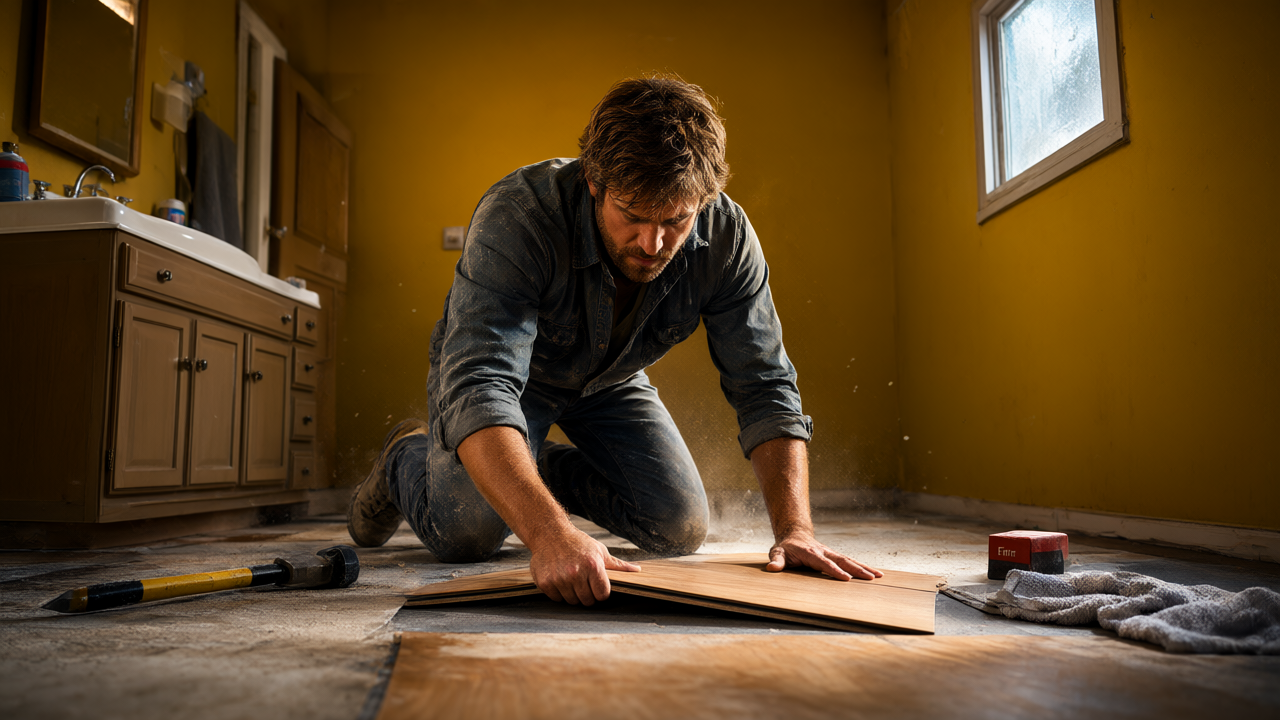
5 Waterproofing Truths: What Actually Keeps Moisture Out in 2026
Here is what separates a bathroom vinyl floor that lasts 15 years from one that starts peeling in 18 months. These are the five things that matter, in order of how often they cause callbacks.
Truth 1: Waterproof planks are not a waterproof floor. A luxury vinyl plank rated for full water submersion protects the core. It does nothing about the seams between planks or the perimeter gap at the wall. Water travels through those paths, sits on the subfloor, and breeds mold in a dark cavity you cannot see. If you want a genuinely watertight bathroom floor, sheet vinyl with heat welded seams outperforms plank every time. Plank wins on looks and repairability. Know which one you are buying.
Truth 2: The underlayment matters more than the plank. Over concrete, you need a moisture barrier and a self leveling compound. Over wood, you need a smooth, rigid, dry substrate. A 6 mil polyethylene vapor barrier under a floating vinyl plank floor runs roughly $0.25 to $0.50 per square foot in materials. Skipping it to save $40 on a 160 square foot bathroom is the most expensive $40 a homeowner can save.
Truth 3: Acclimate the material, and acclimate it longer than the box says. Most manufacturers print 48 hours. In a Cary bathroom in October, with the heat just coming on and indoor humidity dropping, give it 72 hours minimum, laid flat, in the room where it will be installed. Planks that go down cold and dry will gap at the seams once they warm up.
Truth 4: Toilets and tubs are where floors die. The wax ring on a toilet fails quietly. By the time you smell it, the subfloor under the flange is compromised. Same story with a tub or shower pan that was set without a proper bead of sealant at the floor line. Vinyl installed tight to a tub apron with no flexible sealant bead will wick water under the edge from every splash. A $12 tube of 100 percent silicone applied correctly prevents a $2,000 repair.
Truth 5: Perimeter gaps are not optional, and they are not a leak. Every floating vinyl floor needs a 1/4 inch expansion gap at every wall, cabinet toe kick, and door jamb. That gap gets covered by baseboard or quarter round. Homeowners see daylight in that gap during install and panic, then caulk it shut. That caulk is what causes the buckle. Let the floor move.
Seams, Perimeter Gaps & Subfloor Prep: Where Bathroom Vinyl Fails
If you want to know why a bathroom vinyl floor failed, you do not need to pull up the whole thing. Look at three places.
The seam at the doorway. This is the highest traffic point in the room and the transition to the hallway flooring. If the installer ran the plank tight against the door jamb with no gap and no transition strip, that seam will open first. A proper T molding or reducer, plus a 1/4 inch gap on both sides, costs about $15 and takes ten minutes.
The perimeter around the toilet. Pull the toilet. Do not cut around it. A floor cut around a toilet flange with a jigsaw leaves a gap that the wax ring cannot seal. The correct sequence is toilet out, flange inspected, floor installed, new wax ring, toilet back down. Any installer who tells you they can do it without pulling the toilet is saving themselves 30 minutes and costing you a floor.
The subfloor flatness. Industry standard is no more than 3/16 inch variance across a 10 foot span. Check it with a 6 foot straightedge before anything goes down. High spots get sanded. Low spots get filled with a patching compound, typically $30 to $45 per 25 pound bag. A 5 by 8 foot bathroom usually needs one to two bags.
Here is the prep sequence that works, in order:
- Pull the toilet, remove the old flooring, and inspect the subfloor for soft spots or previous water damage.
- Check flatness with a 6 foot straightedge in at least four directions.
- Repair or replace any compromised plywood. Rotted sections get cut out and patched, not covered.
- Fill low spots with patching compound and let it cure fully, usually 24 hours.
- Sand high spots and vacuum thoroughly. Dust under vinyl creates bumps.
- Install the vapor barrier or underlayment per the manufacturer's spec.
- Acclimate the planks in the room for 72 hours.
- Install with the required 1/4 inch perimeter gap, using spacers.
- Reinstall the toilet with a new wax ring and check the flange height.
- Seal the tub or shower base to the floor with 100 percent silicone.
- Install baseboard or quarter round to cover the perimeter gap.
- Wait 24 hours before any water hits the floor.
That list is roughly a two day job for one experienced person in a standard Cary bathroom, and it is the difference between a floor that lasts and a floor that gets replaced.
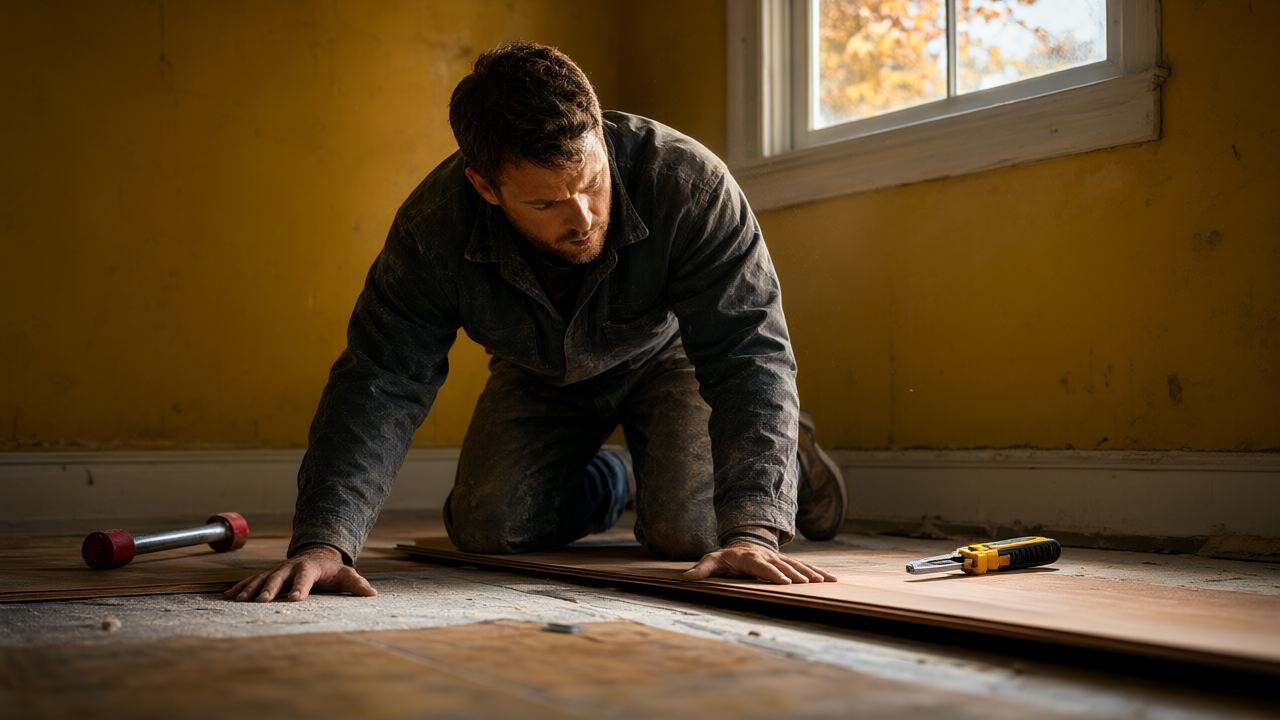
Mold, Mildew & Winter Humidity: Protecting Cary Bathroom Floors All Year
Northern Illinois winters are dry indoors, which sounds like good news for a bathroom floor. It is not. Low indoor humidity pulls moisture out of wood subfloors and vinyl planks alike, and the resulting contraction is what opens seams. Then spring arrives, humidity climbs back into the 60s, and water finds those open seams before the material has finished expanding.
The fix is not complicated. Run the bathroom exhaust fan for 20 minutes after every shower, not five. Check that the fan actually moves air. A cheap way to test: hold a square of toilet paper up to the grille. If it does not hold, the fan is undersized or the duct is blocked. Most builder grade fans in Cary homes move 50 CFM. For a bathroom over 100 square feet, you want 110 CFM minimum. A replacement fan runs $90 to $180 and takes about an hour to swap.
Keep indoor humidity between 30 and 50 percent through the winter with a whole house humidifier or a portable unit. Under 30 percent and your flooring materials dry out and shrink. Above 50 percent and you are feeding mold in the wall cavity behind the shower.
Watch for the early warning signs before they become a tear out:
- Cupping or curling at plank edges. That is moisture from below, not from spills on top.
- A soft spot near the toilet or tub. Press with your heel. Any give means the subfloor is compromised.
- Musty smell that does not clear after ventilation. Mold is growing somewhere the light does not reach.
- Seams that open in February and close in July. Seasonal movement is normal, but visible gaps mean the floor was installed too tight.
- Discoloration on the baseboard or drywall above the floor line. Water is wicking up, not sitting on the surface.
Any two of those together means it is time to pull up a section and look underneath. Catching it at that stage is a $300 to $600 repair. Catching it a year later is a subfloor replacement and a full reinstall.
When to Call a Cary Carpentry Pro vs. DIY Vinyl Installation
Here is the honest version, because not every bathroom vinyl job needs a contractor.
Do it yourself if: the subfloor is flat and dry, the existing flooring is already vinyl or a single layer of sheet goods, the toilet flange is at the right height, and you are working with a rectangular bathroom with no unusual cuts. A 5 by 8 foot powder room over a sound subfloor is a realistic weekend project for a careful homeowner. Expect $2.50 to $4.50 per square foot in materials for mid grade luxury vinyl plank, so $100 to $180 for the room.
Call a pro if: you are pulling up tile or a mud bed, the subfloor has any soft spots, the toilet flange is below the finished floor height, you have a walk in shower or a curbless transition, or the room has more than two inside corners and a doorway. Those are the jobs where a $400 DIY savings turns into a $3,000 correction. Full bathroom vinyl installation through Burns Carpentry typically runs $6 to $12 per square foot installed in the Cary area, depending on subfloor condition and whether the toilet and vanity come out.
If you are comparing bids, ask three questions. How do you handle the toilet flange? What is your subfloor flatness tolerance, and how do you measure it? What happens if you find rot under the old floor? A contractor who answers those without hesitating has done this before. One who says "we'll figure it out" has not.
Burns Carpentry handles vinyl Flooring Installation across Cary and the surrounding areas, along with Deck Building, Basement Finishing, and full flooring installation for homeowners who would rather not gamble on the subfloor. Andy Burns and the crew work out of Cary and cover Arlington Heights, Elgin, Palatine, Schaumburg, and the rest of the northwest suburbs. Free estimates, and they will tell you straight if your bathroom is a DIY job.
Frequently Asked Questions
How much does vinyl flooring installation cost in Cary, IL?
Most Cary bathroom vinyl installations run $6 to $12 per square foot installed, including materials, prep, and labor. A standard 5 by 8 foot bathroom lands between $240 and $480. Add $150 to $400 if the toilet and vanity need to come out, and more if the old floor is tile or a mud bed that has to be demoed.
Is vinyl flooring actually waterproof in a bathroom?
The planks are waterproof. The floor assembly is not, unless the seams and perimeter are handled correctly. Water gets through plank seams, around the toilet flange, and under the tub edge. Sheet vinyl with heat welded seams is the most watertight option. Luxury vinyl plank is water resistant and repairable, which is why most homeowners choose it, but it still needs a vapor barrier underneath and a proper seal at every fixture.
How long does a bathroom vinyl floor installation take?
A typical Cary bathroom takes two to five days from demo to finished floor, depending on subfloor condition. If the subfloor is sound and the old flooring comes up clean, two days is realistic. If there is rot, a mud bed to remove, or a flange height issue, plan on four to five. You will have the bathroom back the same day the floor goes down, but stay off it for 24 hours.
Do I need to pull the toilet to install vinyl flooring?
Yes. Any installer who tries to cut around the toilet is leaving a gap that the wax ring cannot seal, and that gap is where the subfloor rots. Pulling the toilet takes 20 minutes and a new wax ring costs about $8. It is the single cheapest step in the whole job and the one most often skipped.
If you are in Cary and your bathroom floor has soft spots, open seams, or a musty smell that will not quit, that is beyond a weekend project. Call Burns Carpentry at their Cary shop. They will walk the room with you, tell you what the subfloor looks like under the old floor, and give you a straight number. If it turns out to be a DIY job, they will say so.