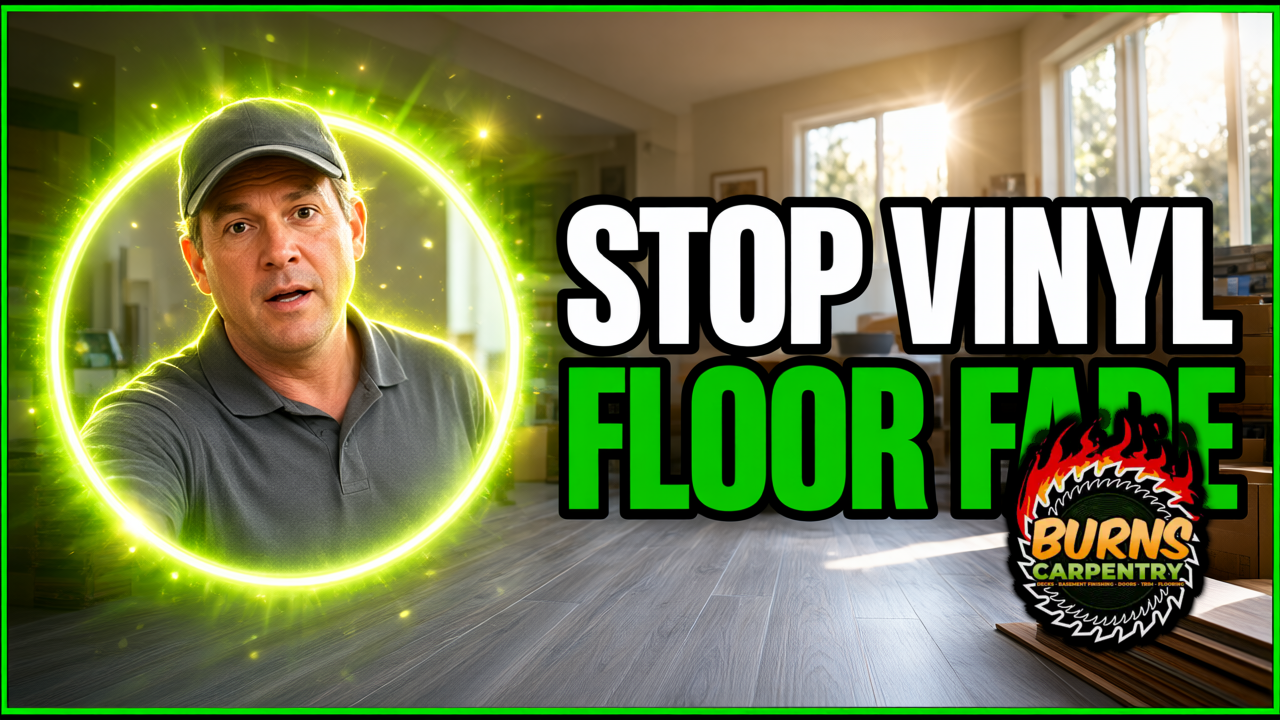
Here's the frustrating truth about Vinyl Flooring fade in Cary, IL: the same southern exposure that gives your living room that gorgeous afternoon light is quietly baking your floor planks at a rate most homeowners never notice until the color shift is permanent. Vinyl flooring fade and discoloration is real, it's cumulative, and in the Chicago northwest suburbs it happens faster than the manufacturer's warranty language lets on. A west-facing great room with a bank of Andersen windows can accumulate enough UV exposure over three summers to turn a warm gray plank into something closer to pale taupe, and no amount of mopping brings it back. The good news is that most of this damage is preventable if you know what you're looking at and what to specify before the boxes ever come off the truck.
Why South and West Facing Rooms in Cary Homes Fade Vinyl Faster
Walk through any subdivision off Three Oaks Road or out near the Fox River and you'll notice the same architectural pattern: builder floor plans from the late 1990s through the 2010s leaned hard on large south and west facing window walls for passive solar gain and open sightlines. Great. For your heating bill in January. Terrible for any flooring product with a printed wear layer.
Here's the physics in plain English. Ultraviolet light carries enough energy to break the chemical bonds in the pigments and print layers that give vinyl its color. South facing glass in northern Illinois receives direct sun most of the day from roughly March through October, and west facing glass takes the worst of it between 2 p.m. and sunset, when the sun angle is low and the rays come in nearly horizontal. That low angle means the light penetrates deep into the room instead of hitting the window sill, which is exactly how a fade pattern gets established in a band across the middle of your floor rather than just at the edges.
McHenry County also sits at a latitude where summer sun angles stay high enough, long enough, that you get roughly five to six months of meaningful UV exposure per year, not the three months a lot of people assume. Add the reflection off a light-colored driveway or a paver patio and you can multiply the effective dose hitting your floor. Vinyl plank in a west-facing Cary kitchen with a sliding glass door is the single fastest-fading installation scenario I see.
The other piece people miss: heat. A sunlit vinyl floor near a window can hit 110 to 130 degrees Fahrenheit on a July afternoon, and thermal expansion plus UV exposure together age the wear layer faster than either one alone. That's why the fade often shows up with curling seams and gapping at the ends of planks, not just a color change.
5 Signs Your Vinyl Flooring Is Fading (And What Causes It)
Most homeowners catch vinyl fade late, because the change is gradual and the room's furniture hasn't moved. It's the shadow lines that give it away. Here's what to look for, and what each sign actually means.
- Ghost outlines under area rugs and furniture. Pull up a rug that's sat in the same spot for two years and compare the floor underneath to the surrounding planks. If you can see a crisp rectangle of richer color, you've got UV fade. This is the most reliable early indicator.
- A visible color shift toward yellow or gray. Vinyl prints don't fade uniformly. Warm tones tend to go chalky and cool tones tend to go yellow, which is why a gray plank can read greenish after a few summers.
- Uneven fade across the room. If the floor near the window is lighter than the floor near the interior wall, the pattern tracks the sun path. Measure the difference with a scrap of the original material if you have one saved from installation.
- Wear layer scuffing that won't clean up. When the clear wear layer itself degrades, it goes slightly hazy and picks up scuff marks that a normal cleaner won't lift. That's a different problem from surface dirt, and it's not fixable.
- Curling edges and gapping at plank ends. Heat cycling and UV exposure together dry out the plank core. Once the edges lift, moisture gets underneath and the fade accelerates from the seams inward.
The cause in almost every case comes back to three things: direct UV exposure, heat cycling, and a wear layer that wasn't rated for sun. Cheap builder-grade vinyl with a 6 mil wear layer will fade noticeably in two to three summers in a west-facing Cary room. A quality product with a 20 mil wear layer and a UV-cured coating holds up far longer, but even premium vinyl isn't immune. It's slower, not bulletproof.
UV Stable Vinyl Options Worth Specifying for Cary, IL Installations
If you're replacing faded flooring or building out a new room, the specification conversation matters more than the brand name on the box. When Burns Carpentry handles Vinyl Flooring installation in Cary, the questions we ask before ordering a single box are about sun exposure, not just style and budget.
What to look for on the spec sheet:
- Wear layer thickness of 20 mil or higher for any room with direct sun. Luxury vinyl plank in the 12 mil range is fine for a basement or a hallway. It's a mistake in a sunroom.
- A UV-cured polyurethane or ceramic bead coating on the wear layer. This is the single biggest factor in fade resistance, and it's listed in the product data sheet even if the box doesn't advertise it.
- Manufacturer fade warranties in writing. Good products carry a 10 to 20 year residential fade warranty. Ask for the warranty document, not just the marketing language. Read the exclusions, because most of them exclude damage from "excessive sun exposure," which is a phrase that gives the manufacturer a lot of room.
- Rigid core (SPC) construction over flexible glue-down vinyl for sun-exposed rooms. The rigid core handles heat cycling better and resists the curling that shows up in cheaper products.
One insider note worth sharing: the printed pattern on vinyl is a photograph, and different patterns within the same product line fade at different rates depending on the ink saturation. A light, washed-out oak print will show fade less than a deep, saturated walnut print. If you're set on a dark, rich color in a sunny room, plan on window treatments from day one. It's a design decision, not a defect.
Prevention Tactics: Window Film, Rugs, and Furniture Rotation Schedules
The most effective fade prevention in a Cary home costs less than a single box of replacement flooring, and it starts with understanding where the sun actually lands. Do this: on a sunny Saturday in late September, spend an hour tracking the sun path through your sunniest room. Put a piece of painter's tape on the floor at 10 a.m., 1 p.m., and 4 p.m. marking the edge of the direct light. You'll have a map of the fade zone by dinnertime.
Here's the prevention checklist that actually works:
- UV window film. A quality residential film blocks 99 percent of UV and 60 to 80 percent of solar heat gain, and professional installation runs roughly $8 to $15 per square foot in the Cary area. A typical west-facing great room with 150 square feet of glass lands around $1,500 to $2,200. Worth it, and it pays back on cooling costs too.
- Solar shades or UV-blocking cellular shades. A mid-grade solar shade on a large window runs $250 to $600 installed. Use them during peak sun hours, roughly 11 a.m. to 5 p.m. in summer. You don't need them down all day, just during the worst window.
- Area rugs in the fade zone. A rug protects the floor underneath but creates a fade contrast at the edges, so rotate it 90 degrees every six months to even out the exposure.
- Furniture rotation schedule. Every four to six months, move the sofa, area rug, and any large piece that shades the floor. Set a reminder on your phone for the first weekend of April and October. This is the single most overlooked tactic and it costs nothing.
- Exterior shade. A pergola, awning, or well-placed tree on the west side cuts the low-angle sun that does the most damage. Burns Carpentry builds Pergola Building projects across Cary specifically for this reason, and a west-facing pergola over a patio door or slider makes a measurable difference to interior UV exposure.
One honest word: if your vinyl is already faded, none of these tactics reverse it. They stop the clock from running any further. Prevention is a decision you make before the fade, not after.
When Faded Vinyl Warrants Replacement vs. Room by Room Patching
This is the question I get most often, and the honest answer depends on three things: the size of the faded area, whether the fade is uniform or patchy, and whether you have matching material saved from the original installation.
Patch it if: the fade is confined to one room or a defined zone, you have matching planks in the attic or garage (builders and installers often leave a box or two), and the planks are still available from the manufacturer. A patch job on a 200 square foot sunroom typically runs $600 to $1,200 in labor and materials, and a good installer can blend the seam so it's barely visible.
Replace it if: the fade is uneven across multiple rooms, the wear layer has degraded and scuffed, the planks are curling, or the product has been discontinued. A discontinued pattern is a dead end. No installer can match it, and hunting for remnants online is a losing game. In that case, replacing the whole room is the only path to a uniform look.
One thing worth knowing: if the faded floor is still under a manufacturer's fade warranty, read the exclusions carefully before you rip it out. Most warranties cover "manufacturing defects" but exclude sun damage, and the manufacturer will ask for photos and proof of purchase. It's worth a phone call, but don't count on a payout.
Replacing vinyl in a single 300 square foot Cary room with quality material and installation typically runs $2,400 to $4,800 depending on the product line. That's the real number to plan around, not the bargain box price at the big box store.
Frequently Asked Questions
How long does vinyl flooring last in a sunny Cary room?
A quality vinyl plank with a 20 mil wear layer and UV-cured coating typically holds its color for 10 to 15 years in a sun-exposed room, but cheap builder-grade vinyl can show visible fade in two to three summers. The wear layer thickness and the coating matter more than the brand.
Can I stop vinyl flooring from fading?
You can slow it down significantly with UV window film, solar shades, rug rotation, and furniture rotation every four to six months. You cannot reverse fade once it happens, so prevention is the only real solution.
Does window film actually protect vinyl flooring from UV damage?
Yes. A quality residential window film blocks 99 percent of UV light and is the single most effective prevention tactic for sun-exposed vinyl. Professional installation runs roughly $8 to $15 per square foot in the Cary area.
Can faded vinyl planks be repaired without replacing the whole floor?
Sometimes. If the fade is confined to one area and you have matching planks or the product is still available, a patch job is realistic and typically runs $600 to $1,200. Discontinued patterns or multi-room fade usually mean full replacement.
If you're in Cary or anywhere across the northwest suburbs and your vinyl is showing the ghost outlines and color shift that mean fade has set in, Burns Carpentry handles Vinyl Flooring Installation and can tell you straight up whether a patch will hold or whether it's time to replace. They'll also walk you through the UV-stable product specs before you order a single box, which is the conversation that saves you from doing this twice. Give them a call, and bring your sun map and your warranty paperwork.