You just spent $4,200 on vinyl plank flooring for your Cary home. Six weeks later, it sounds like a mouse is tap dancing under your kitchen table every time you cross the room. Before you grab a crowbar, take a breath. Roughly 70% of the squeaky Vinyl Flooring complaints we hear about in McHenry County trace back to one of five fixable causes, and only a fraction of them require pulling up planks. The rest are diagnosed and silenced in an afternoon, sometimes for less than the cost of a decent hammer drill.
Why Vinyl Planks Squeak or Pop: 5 Causes in Cary, IL Homes
Vinyl flooring gets sold as the low maintenance, quiet alternative to hardwood. That's mostly true, but "mostly" is doing a lot of work in that sentence. Plank vinyl, whether it's luxury vinyl plank (LVP) or rigid core, relies on a locking system and a flat substrate to stay quiet. When either of those fails, you get noise. Here's what's actually happening under your feet.
Cause 1: Subfloor flatness. Vinyl plank manufacturers typically call for flatness within 3/16 of an inch over a 10 foot span. That's a tight tolerance. Older Cary homes, especially the 1970s and 1980s builds around the Fox River, often have plywood subfloors with dips and humps from decades of settling and seasonal humidity swings. When a plank bridges a low spot, every step flexes it slightly and the locking tab grinds against its neighbor. That's your pop.
Cause 2: Missing or thin underlayment. Some vinyl planks come with attached pad. Some don't. Homeowners who install the no-pad version directly over a wood subfloor without a proper underlayment get transfer noise from every footstep. We've walked into living rooms in Cary where the installer skipped underlayment entirely to save $0.40 per square foot, and the floor sounds hollow and loud as a result.
Cause 3: Failed locking joints. Planks that weren't fully seated during installation, or that were tapped too hard and cracked the locking tab, loosen over time. Once a joint separates by even a millimeter, it rubs. Prairie humidity swings from 20% in January to 70% in July push the material back and forth, and that gap grows.
Cause 4: Expansion gap problems. Vinyl is dimensionally stable compared to hardwood, but it still moves. Installers who butt planks tight against a wall or cabinet, or who forget the expansion gap under shoe molding, create pressure that forces joints up and apart. You hear the result as a crack or pop near the room's edges.
Cause 5: Loose subfloor fasteners. This is the sneaky one. A squeak that sounds like it's coming from the vinyl might actually be the plywood subfloor rubbing against a joist because a nail backed out. The vinyl amplifies the sound like a drumhead. We've solved more than a few "vinyl squeaks" by driving screws from below in a basement or crawlspace.

Diagnosing the Sound: Is It the Subfloor, Underlayment, or Locking System?
Before you touch a thing, spend fifteen minutes running a diagnostic. The sound tells you almost everything. Grab a friend, a flashlight, and a pencil, and work through this checklist.
- Walk the room slowly in socks. Mark with pencil on a piece of paper (not on the floor) where each squeak or pop happens. Patterns matter. Noise along a straight line usually means a loose subfloor seam or joist. Noise at random spots means plank flex.
- Press down hard on the noisy plank with your heel. If the plank dips and the joint clicks, it's a flatness or locking problem. If the plank doesn't move but you still hear a creak, the noise is below the vinyl.
- Listen from the floor below. If you have a basement or crawlspace, have someone walk overhead while you listen from underneath. A creak that's loudest from below is a subfloor fastener issue, not a flooring issue.
- Check the perimeter. Pull back a piece of shoe molding or quarter round at the noisy wall. If the plank is tight against the drywall with zero gap, you found an expansion problem.
- Test the temperature theory. Squeaks that only show up in winter or only in summer point to humidity related movement. Cary's climate swings hard between seasons, and that's a clue.
Write down what you find. A good carpenter can read those notes and give you a real estimate before showing up. If a contractor won't ask you any diagnostic questions before quoting a repair, that's a red flag worth noting.
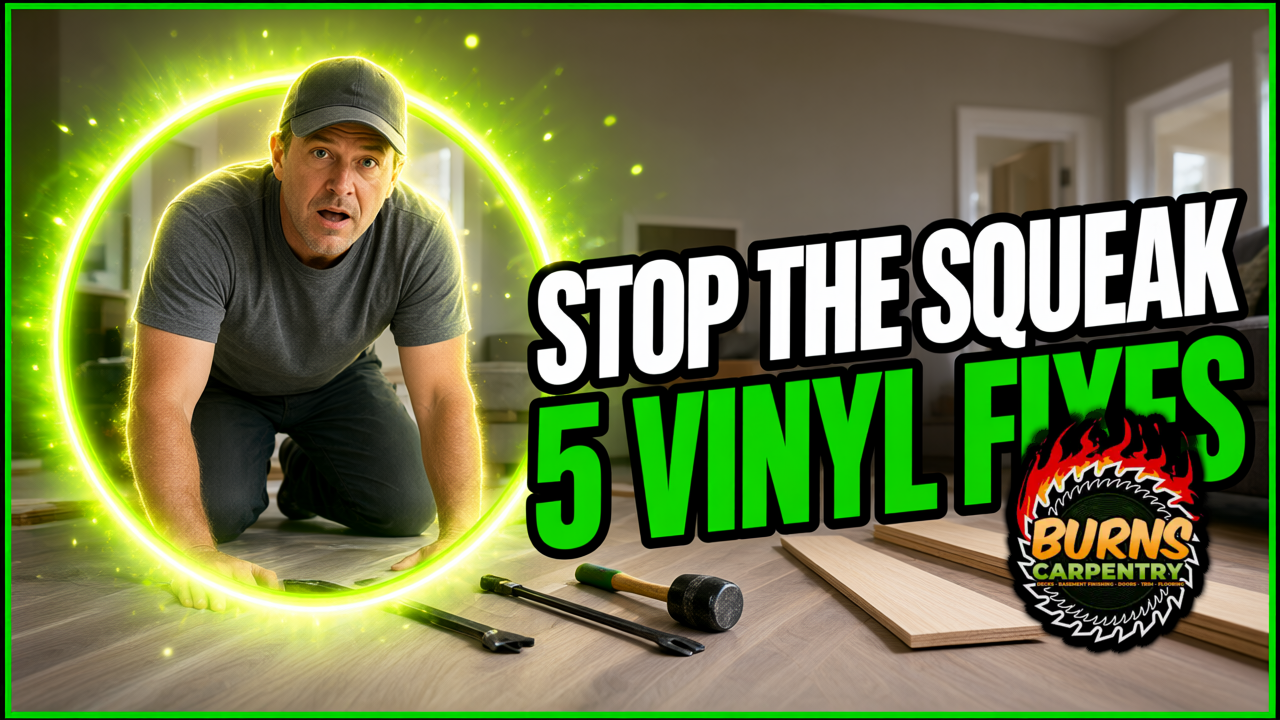
5 Fixes for Squeaky Vinyl Flooring (Before You Rip It Up)
Here's the order we recommend. Start with the cheapest, least invasive fix and work up. Most homeowners stop at step two.
- Reset the expansion gap. If you found planks tight against a wall, pull the shoe molding, score the drywall edge with a utility knife, and trim the plank with a multi-tool to leave a 1/4 inch gap. Replace the molding. Cost: your afternoon and about $30 in trim. This solves more perimeter pops than any other single fix.
- Inject adhesive under floating planks. For a plank that dips and pops in the middle of the room, drill a 3/16 inch hole through the top surface (yes, really) and inject a low expansion construction adhesive with a syringe. Weight the plank down with a stack of books for 24 hours. Fill the hole with color matched vinyl putty. This is a legit trick and it works. Cost: $20 to $40 in materials.
- Drive screws from below. If the noise is a subfloor creak, go into the basement or crawlspace, locate the noisy joist, and drive 2 inch deck screws up through the subfloor every 6 inches along the joist. Use screws, not nails, and don't overdrive them. Cost: $15 in screws and a couple hours of crawling.
- Add underlayment under a problem area. If a small section was installed without underlayment, a flooring contractor can lift the affected planks, roll out 2mm acoustic underlayment, and reinstall. Expect $400 to $900 for a typical 100 square foot area, depending on how many planks need to be replaced.
- Replace failed planks. When a locking tab is cracked or a plank is visibly lifted, replacement is the answer. Keep a box of spare planks from the original install; if you don't have one, most manufacturers keep dye lots available for 3 to 5 years. A single plank swap runs $150 to $300 in labor for a pro, or a couple hours of your Saturday if you're handy.
Honest talk: if your noise is coming from more than 20% of the floor, or if the planks are visibly lifting at the seams, stop patching and call someone. At that point you're treating symptoms, not the disease.

When Squeaks Signal a Bigger Carpentry Problem
Most squeaks are cosmetic. Some aren't. Here are the situations where noise is a warning sign worth taking seriously, and where a carpenter's eye matters more than a flooring guy's.
If the floor feels spongy or bouncy underfoot, especially near an exterior wall, you may have a joist or subfloor issue that goes deeper than the vinyl. In older Cary homes, we've found joists that were notched too aggressively by a previous remodel, or subfloor panels that were installed with the wrong orientation. Vinyl amplifies the flex because it's a thin, rigid surface over a moving base. If a floor feels soft in one spot, get it looked at before you spend another dollar on flooring repair.
Water damage is the other big one. A pop that appears after a plumbing leak, dishwasher failure, or heavy rain event, especially in a basement or first floor over a crawlspace, could mean the subfloor is swelling or delaminating. Vinyl traps moisture underneath, so the problem compounds silently. Any noise paired with a musty smell, a soft spot, or a visible stain is a call-a-professional situation.
Finally, if your floor was installed over a concrete slab, listen for a hollow, drumlike sound. That usually means the slab has a moisture issue or the vinyl wasn't properly acclimated. Fixing that means addressing the slab, not the planks. Burns Carpentry handles Vinyl Flooring installation and repair across Cary and the surrounding towns, and the crew has pulled up enough problem floors to know the difference between a $200 fix and a $4,000 tear-out. If you're unsure, a free estimate will tell you which one you're facing.
Preventing Future Noise: Installation Tips for Cary Homeowners
If you're planning new vinyl flooring in 2026, the best way to avoid this whole article is to get the install right the first time. Here's what separates a quiet floor from a noisy one.
Check flatness first, always. Before a single plank goes down, run a 10 foot straightedge across the subfloor in every direction. Any gap greater than 3/16 inch needs to be filled with a patching compound and sanded flat. This step adds a day to a typical install and costs $100 to $300 in materials, but it's the difference between a floor that lasts 15 years and a floor that squeaks in year two.
Acclimate the planks. Vinyl needs 48 hours in the room where it will be installed, at normal living temperature. Planks installed straight off a cold truck in January will shrink and separate as they warm up. That's a common cause of joint noise we see on winter installs in the Chicago suburbs.
Use the right underlayment. A 2mm acoustic underlayment runs $0.50 to $1.00 per square foot and cuts impact noise by 15 to 20 decibels. It's the single best upgrade for anyone with a basement or second floor living space above them.
Leave the expansion gap. A 1/4 inch gap at every wall, cabinet, and transition strip. No exceptions. Cover it with shoe molding and forget it exists.
Ask about the warranty before you sign. Burns Carpentry guarantees workmanship for two full years from project completion, and the vinyl materials carry their own manufacturer warranty. If a joint fails in month 14, that's covered. Ask any installer you hire for the same commitment in writing.
If your vinyl flooring has gone from quiet to cranky, or if you're planning a new install and want it done right the first time, Burns Carpentry handles Flooring Installation and Vinyl Flooring projects across Cary and McHenry County. The crew has seen every flavor of squeak this side of the Fox River, and a free estimate will tell you straight up whether you're looking at a Saturday afternoon fix or something bigger. Give them a call, and bring your diagnostic notes. They'll appreciate it.
Frequently Asked Questions
How much does it cost to fix a squeaky vinyl floor in Cary, IL?
Most single-area repairs run $150 to $400 if a pro handles it, and many are covered by workmanship warranties if the floor was installed in the last two years. Whole-room repairs where multiple planks need replacing can hit $900 to $1,500. If the noise is a subfloor issue, expect $300 to $800 depending on access.
Can I fix squeaky vinyl plank flooring myself?
Yes, for perimeter pops and isolated plank flex. Trimming an expansion gap or injecting adhesive under a loose plank takes an afternoon and under $50 in materials. Subfloor fastener issues and widespread joint failures are worth hiring out, mostly because diagnosing them wrong wastes time and money.
Is it normal for new vinyl flooring to pop for the first few months?
A little settling noise in the first 30 to 60 days is normal as the planks acclimate to your home's humidity. After 90 days, persistent popping is not normal and usually points to a flatness, underlayment, or locking issue that should be addressed under warranty.
Should I replace vinyl flooring with something quieter?
Not necessarily. Properly installed vinyl over a flat subfloor with acoustic underlayment is one of the quieter flooring options available. If your current floor is noisy, the fix is almost always in the substrate and installation, not the material itself.