Here's the problem nobody warns Cary homeowners about: the vinyl plank floor that looks bulletproof in the showroom can start curling at the seams within two heating seasons if it's laid over a radiant slab without the right prep. Radiant heat is one of the best comfort upgrades you can put in a northern Illinois house, and luxury vinyl plank is one of the best flooring values on the market right now. Put them together carelessly, though, and you get gapping, telegraphing, and adhesive failure that no warranty will cover. This guide covers how Vinyl Flooring and radiant heat actually interact, which vinyl products hold up, how the install has to change, and what it costs in 2026.
How Radiant Heat Affects Vinyl Flooring in Cary, IL Homes
Radiant heat warms a floor from below, which means your vinyl is being heated from the back side rather than the top, and that changes everything about how the material behaves. Vinyl is a plastic product. It expands when warm and contracts when cool, and a hydronic or electric radiant system cycles the slab temperature up and down all winter. In a Cary house running radiant heat from roughly November through March, that's five months of daily expansion and contraction cycles, and the flooring has to be installed in a way that absorbs that movement without buckling.
The second issue is temperature ceiling. Most luxury vinyl plank and tile manufacturers cap the acceptable surface temperature at about 85 to 87 degrees Fahrenheit. Push a heated floor above that and you risk the wear layer delaminating from the core, plank edges cupping, and adhesive softening under glue down installations. That's why the thermostat setting on your radiant system matters as much as the flooring you pick. A slab that feels pleasantly warm to bare feet is usually running around 75 to 80 degrees at the surface, which is safely inside the range. A slab set to 90 degrees because someone wants a toasty bathroom floor is asking for trouble.
There's also the moisture question, and this one catches people in older homes. Concrete slabs wick moisture, and in McHenry County basements and slab on grade additions, that moisture has to be managed before any flooring goes down. Vinyl is water resistant on its face, but moisture vapor coming up from below can trap under the plank, degrade adhesive, and cause a musty smell. Any slab receiving vinyl over radiant heat should be tested for moisture vapor emission before installation, typically with a calcium chloride test or an in situ relative humidity probe. If the numbers come back high, you need a vapor barrier or a moisture mitigation coating first, not a thicker underlayment.

5 Vinyl Flooring Types That Work Best Over Radiant Heat
Not all vinyl is built for a heated subfloor, and the differences matter more than the marketing copy on the box suggests. Here are the categories that perform well in Cary homes, ranked by how forgiving they are over radiant systems.
1. Rigid core luxury vinyl plank (SPC). Stone polymer composite is the current workhorse. The mineral core is dimensionally stable, handles temperature swings well, and clicks together tightly. Look for a plank with a wear layer of at least 20 mil for a main living area. SPC is the safest bet over radiant heat in most Cary installations.
2. WPC luxury vinyl plank. Wood plastic composite has a slightly softer, warmer feel underfoot and better sound absorption, which homeowners with second floor radiant or a basement rec room tend to appreciate. It's a little more sensitive to heat than SPC, so confirm the manufacturer's radiant heat rating before you buy.
3. Glue down luxury vinyl tile. Popular in basements and bathrooms, glue down LVT transfers heat efficiently and sits flat with no clicking or floating. The catch is adhesive selection. You need a high temperature adhesive rated for radiant heat, not the standard pressure sensitive stuff.
4. Loose lay vinyl plank. These heavier planks grip the floor without adhesive and are easy to pull up for repairs. They work over radiant heat but demand a very flat subfloor, typically within 1/8 inch over 10 feet.
5. Sheet vinyl with a felt or foam backing. Still a solid choice for kitchens and laundry rooms. The backing adds a little insulation, which slightly slows heat transfer but also cushions the material. Skip the cheapest builder grade sheet goods; they telegraph every imperfection in the slab.
What to avoid: thin, flexible peel and stick planks, anything with a wear layer under 12 mil over a heated slab, and any product whose installation instructions don't explicitly mention radiant heat. If the box doesn't address it, assume it's not rated for it.
Installation Tips for Vinyl Flooring Over Heated Subfloors
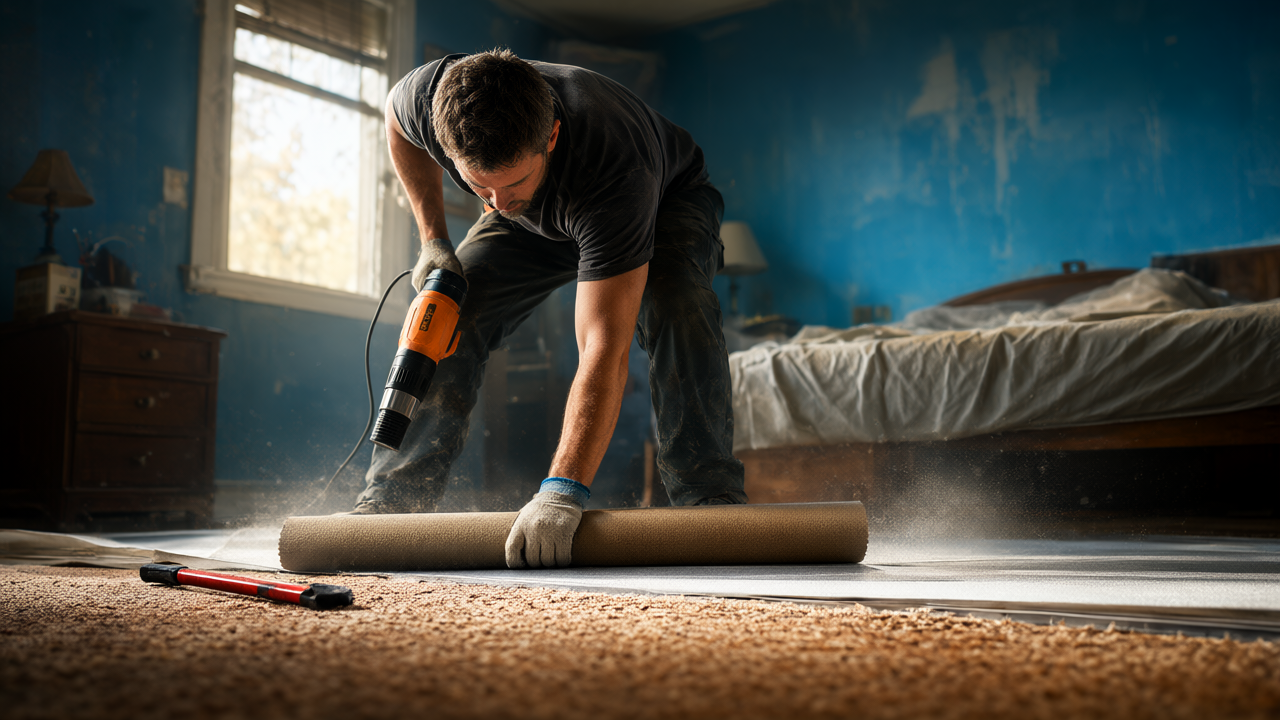
Installation is where most radiant heat flooring failures begin. The product is usually fine. The prep and the sequencing are where things go wrong. Burns Carpentry handles Vinyl Flooring and Flooring Installation across Cary and the surrounding towns, and the process below is the sequence that keeps these floors flat and quiet for the long haul.
- Test the slab for moisture first. No exceptions. Calcium chloride or RH probe testing before anything else gets unloaded from the truck.
- Flatten the substrate. Radiant slabs are rarely perfectly flat. Grind high spots, fill low spots with a patching compound, and verify with a 10 foot straightedge. Floating vinyl needs flat, not level, but it needs genuinely flat.
- Turn the heat off 48 to 72 hours before installation. The room should be at normal indoor temperature, roughly 65 to 75 degrees, when the planks go down. Installing over a hot slab locks in expansion that will show up as buckling later.
- Acclimate the flooring. Leave boxes in the room for at least 48 hours so the planks adjust to the space's temperature and humidity.
- Use the right underlayment. A thin, high density underlayment rated for radiant heat. Skip the thick foam pads; they trap heat and create a spongy feel that stresses the locking joints.
- Leave expansion gaps at every wall and fixed object. Typically 1/4 inch. Cabinets, door frames, and pipes all need clearance.
- Bring the heat back up gradually. After installation, raise the thermostat about 5 degrees per day over several days. Never jump straight to full temperature.
One more detail that matters in Cary: seasonal timing. If you're installing in late fall, the house may already be running heat. Coordinate with your installer so the system is off during the actual install window. In summer, air conditioning can dry the air out and cause planks to shrink slightly, so humidity control in the 35 to 55 percent range keeps the material stable year round.
Common Problems with Vinyl Flooring and Radiant Heat (And How to Fix Them)
The failures we see fall into a handful of predictable categories, and most of them trace back to something that was skipped during prep or temperature management.
Gapping at the seams. Planks pull apart when the floor is installed too tight against walls or when the room swings between very dry winter air and humid summer air. The fix is expansion gaps and humidity control. If it's already happened, a flooring pro can sometimes relay the affected run, but prevention is far cheaper.
Cupping or crowning. Edges lift or centers bow, usually from heat that's too high or moisture trapped under the plank. Drop the thermostat setting, verify the slab moisture reading, and check that the underlayment isn't trapping vapor.
Telegraphing. Every bump and ridge in the slab shows through the vinyl. This is a flatness problem, not a flooring problem. The only real fix is pulling the floor and grinding or patching the substrate properly.
Adhesive failure on glue down jobs. The tile lifts at the corners because the wrong adhesive was used or the slab was too warm during install. High temperature adhesive and a cool slab at install time solve this.
Delamination of the wear layer. Usually a sign the floor has been running above the manufacturer's temperature limit for a long stretch. Check the thermostat, and check whether the radiant system has a floor sensor or is running on a fixed slab temperature that's too high.
Red flag to watch for: any installer who doesn't ask about your radiant heat system, doesn't test slab moisture, or tells you the floor flatness is "close enough." Those three shortcuts cause most of the callbacks we see.
Cost Considerations for Vinyl Flooring with Radiant Heat in 2026
Budgeting for this project means adding a few line items that a standard vinyl install doesn't carry. Material alone for luxury vinyl plank runs roughly $3 to $7 per square foot in the Cary area in 2026, depending on wear layer and brand. Add installation labor at $2 to $4 per square foot, and you're at $5 to $11 per square foot for a straightforward job.
The radiant heat prep adds cost. Moisture testing runs $100 to $300. Slab grinding and patching for flatness typically adds $1 to $3 per square foot depending on how bad the substrate is. A moisture mitigation coating, if needed, adds another $1 to $3 per square foot. High temperature adhesive for glue down tile runs a bit more than standard adhesive, usually $20 to $40 more per bucket. On a 500 square foot basement, that prep work can add $800 to $2,500 to the total, and it's the difference between a floor that lasts 15 years and one that needs replacing in three.
Where you can save: if your slab is already flat and dry, and you choose a click lock SPC plank you're comfortable installing yourself, a small room like a bathroom or laundry can be a reasonable DIY project. Where you shouldn't: large open areas, glue down over radiant, and any slab with known moisture issues. Those are worth the professional labor, and honestly, a flooring crew will get a 500 square foot room done in two to five days versus your two weekends, with a workmanship guarantee behind it.
If your project in Cary or a nearby town like Arlington Heights, Elgin, or Schaumburg involves vinyl flooring over radiant heat, Burns Carpentry handles Vinyl Flooring and full Flooring Installation with the moisture testing and substrate prep built into the quote. They'll tell you straight up if your slab is ready or if it needs work first, and their workmanship is guaranteed for two years. Call for a free estimate and get the flatness and moisture questions answered before you buy a single box of plank.
Frequently Asked Questions
Can you put vinyl plank flooring over radiant heat?
Yes, as long as the product is rated for radiant heat and the slab surface stays at or below about 85 degrees. Test for moisture, flatten the substrate, and bring the heat up gradually after installation.
What temperature should radiant heat be set to under vinyl flooring?
Keep the floor surface temperature between 75 and 85 degrees Fahrenheit. Most systems run comfortably in that range at a thermostat setting around 70 to 75 degrees for the room.
Does radiant heat ruin vinyl flooring?
Not if it's installed correctly. Problems come from excessive slab temperature, trapped moisture, or an uneven substrate, not from radiant heat itself. Match the product to the system and follow the manufacturer's temperature limits.
How much does vinyl Flooring Installation cost in Cary, IL?
Expect roughly $5 to $11 per square foot installed for standard jobs in 2026, with radiant heat prep adding $1 to $3 per square foot for flattening and testing. Get a quote that itemizes the prep work separately.
If your Cary home has radiant heat and you're ready to put down vinyl that will actually stay flat, Burns Carpentry is the call to make. They'll test the slab, tell you honestly what prep it needs, and install a floor built to handle northern Illinois winters. Free estimates, licensed and insured, and a two year workmanship guarantee.