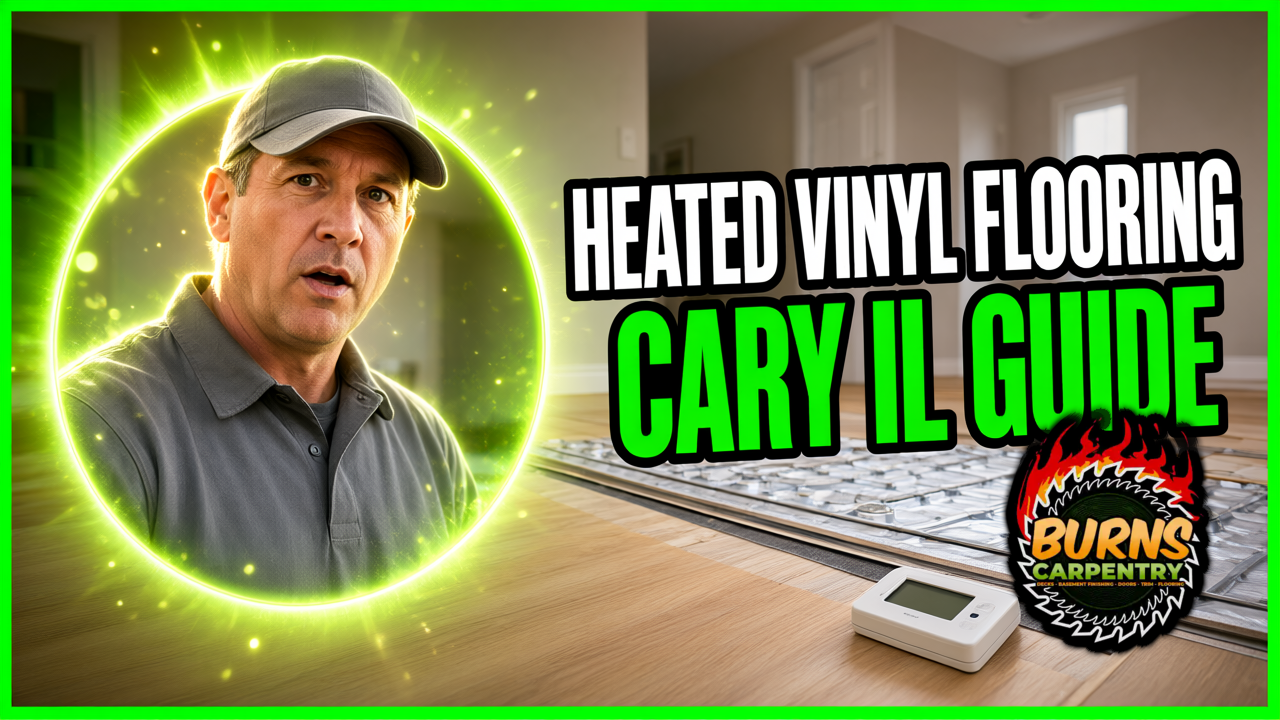
Most homeowners in Cary, IL assume Vinyl Flooring and radiant heat go together like peanut butter and jelly. Then their planks start curling at the seams eight months later. Here is the part nobody tells you at the showroom: only about 30% of vinyl products on the market right now are actually rated for installation over a heated subfloor. The rest will look spectacular on install day and like a science fair experiment by spring. If you are planning a heated vinyl flooring project in Cary, IL in 2026, this guide covers which products survive, which fail, and the exact settings that keep your floor flat for the next 15 years.
How Radiant Heat Changes the Rules for Vinyl Flooring in Cary, IL Homes
Radiant heat is not new. What is new is the number of Cary homeowners pairing it with vinyl plank instead of tile. In a climate where January lows routinely hit 5°F to 15°F and the ground freezes 30 to 42 inches deep, a heated floor stops being a luxury and starts being a quality of life decision. The problem is that vinyl is a thermoplastic. It expands when warm and contracts when cool, and it does this constantly in a radiant heat system that cycles on and off all winter.
Concrete slab temperatures under radiant heat typically swing between 65°F and 85°F during a normal heating season. That 20 degree range sounds small until you do the math on a 30 foot room. A vinyl plank can move roughly 1/16 inch per 10 linear feet for every 10°F of temperature change. In a 30 foot great room, that is nearly a quarter inch of movement, which is exactly why so many DIY installs buckle at the transitions. The flooring has nowhere to go, so it goes up.
There is also a moisture angle specific to Northern Illinois. Cary sits in McHenry County, where basements and slab on grade floors deal with high water tables in spring. Radiant heat actually helps here, because a warm slab drives moisture out instead of letting it wick into the floor. But if the slab is not properly sealed and tested before installation, that same heat will push moisture straight into the vinyl adhesive. A simple calcium chloride test should read 3 lbs per 1000 sq ft per 24 hours or lower before anyone lays a plank. If your installer skips that test, that is your first red flag.
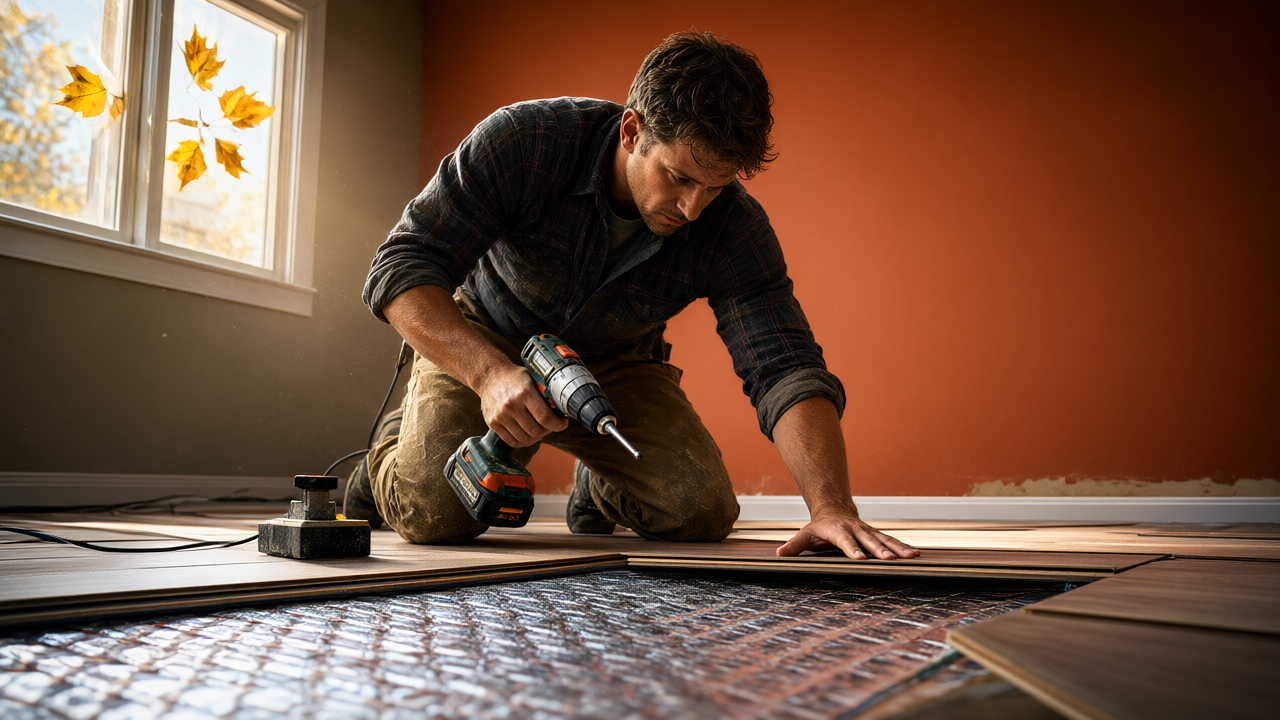
5 Vinyl Flooring Types That Work (and 3 That Fail) Over Heated Subfloors
Not all vinyl is built for this. The category has exploded in the last five years, and the marketing language has gotten loose. Here is the honest breakdown of what holds up over radiant heat and what does not.
What works:
- Rigid core SPC (stone polymer composite) plank: The gold standard. Dimensionally stable, handles temperature swings up to 85°F surface temp, and clicks together tight enough to resist gapping. Expect to pay $4 to $7 per square foot installed in the Cary area.
- WPC (wood polymer composite) with a rigid core: Softer underfoot and warmer to the touch, which matters on a heated floor. Slightly more prone to indentation from heavy furniture, so use felt pads.
- Loose lay luxury vinyl plank (LVP) rated for radiant heat: A solid choice over slab because it does not need adhesive. Confirm the manufacturer's max temp rating in writing.
- Glue down LVP with a flexible, heat rated adhesive: The most stable option over concrete. The adhesive has to be specified for radiant heat, not the standard bucket.
- Sheet vinyl with a felt or foam backing rated for radiant heat: Still the most water resistant option for basements. Less popular aesthetically, but it performs.
What fails:
- Thin, flexible peel and stick vinyl tile: No dimensional stability. It will telegraph every slab crack within one heating season.
- Any vinyl with a max temp rating below 80°F: Radiant systems regularly exceed that at the manifold. Read the spec sheet, not the box.
- Vinyl plank installed directly over electric radiant mats without a self leveling underlayment: The mat wires create high spots, and high spots become cracks.
One insider tip: ask for the manufacturer's radiant heat warranty addendum. If the product is truly approved, the manufacturer will have a one page document that says so. If the salesperson says "yeah, it's fine," walk away.
Installation Steps Cary Homeowners Need for Vinyl Over Radiant Heat
Installation over radiant heat is not the same job as installation over plywood. The prep work takes longer than the actual flooring install in most cases. Here is the sequence that matters.
- Verify the slab or subfloor moisture. Calcium chloride test or in situ relative humidity probe. Target 75% RH or lower for most adhesives.
- Check flatness. Radiant heat floors need to be flat within 3/16 inch over 10 feet. That is stricter than the standard 1/4 inch. Self leveling compound is your friend.
- Let the flooring acclimate. Not the 48 hours the box says. For radiant heat, give it 72 hours in the room at normal living temperature.
- Run the heat before install. Turn the system on for 48 hours, then off for 48 hours, so the slab is at ambient before the first plank goes down. This is called a heat cycle and it prevents trapped moisture.
- Start the heat gradually after install. Do not crank it to 80°F on day one. Increase by 5°F per day over the first week.
If you are hiring this out, the questions to ask are simple. What is your flatness tolerance? Do you do a calcium chloride test? Will you put the product's radiant heat rating in the contract? Burns Carpentry handles Vinyl Flooring and Flooring Installation across Cary and the surrounding suburbs, and the crew will walk you through the moisture testing before a single box is opened. For a Cary basement or kitchen, that testing is the difference between a floor that lasts 15 years and one that needs replacing in three.
Temperature Limits and Thermostat Settings That Protect Your Floor
This is where most homeowners get it wrong, and it is not entirely their fault. Radiant thermostats are usually set to control air temperature, not floor surface temperature. Those are two very different numbers.
The safe ceiling for most vinyl plank is 80°F to 85°F at the floor surface. That is the number you need to control. Air temperature in a Cary living room might be 70°F, but the slab under the vinyl can easily be 15°F warmer than the air. If your thermostat is only reading air, you can cook the floor without knowing it.
What to do:
- Install a floor sensor thermostat if you do not have one. They cost $80 to $150 and they are non negotiable for vinyl.
- Set the floor limit to 82°F. That gives you a safety margin below the 85°F ceiling.
- Never use the "boost" or "fast heat" setting. That feature drives the slab temperature up 10°F in an hour, which is exactly what warps vinyl.
- In deep winter, let the system run steady instead of cycling hard. A floor that stays between 76°F and 80°F all season lasts far longer than one that swings from 65°F to 88°F.
One more thing: if you have a boiler fed hydronic system, check the supply water temperature. Most vinyl manufacturers want it capped at 85°F to 90°F supply temp. Any higher and you are testing the warranty, not the floor.
5 Warning Signs Your Vinyl Flooring Is Reacting to Radiant Heat
Vinyl does not fail overnight. It telegraphs the problem weeks in advance. Here is what to watch for, roughly in the order you will see it.
- Seam gapping in winter. If your planks separate in January and close up in July, the floor is shrinking and swelling beyond its tolerance. Normal movement is 1/32 inch. Visible 1/8 inch gaps mean the product is not rated for your system.
- Cupping at the edges. Edges curl up like a potato chip. This is almost always moisture, not heat, and it points to a missing vapor barrier or a slab that was never tested.
- Discoloration or yellowing in high traffic zones. Heat plus UV plus cheap wear layers equals color shift. It shows up first where the sun hits the floor.
- Soft or spongy spots. If the floor feels bouncy underfoot near the manifold, the adhesive is failing or the underlayment has compressed.
- Click lock separation. Planks that were tight on install day and now slide apart at the ends. This is the classic sign of thermal expansion without expansion gaps at the perimeter.
If you see two or more of these, stop running the heat and get someone to look at it. The earlier you catch it, the more likely the fix is a perimeter trim adjustment instead of a full tear out. For homeowners in Cary, Arlington Heights, or Elgin who want a second opinion, Burns Carpentry can assess whether the issue is installation, product, or thermostat settings. That diagnosis alone saves most people the cost of a full replacement.
Frequently Asked Questions
Is vinyl flooring good over radiant heat?
Yes, if the specific product is rated for it. Rigid core SPC and WPC plank are the safest choices. The key is confirming the manufacturer's maximum surface temperature rating, usually 80°F to 85°F, and pairing it with a floor sensor thermostat. Vinyl that is not rated for radiant heat will cup, gap, and discolor within one or two heating seasons.
What temperature should I set my radiant floor to for vinyl plank?
Cap the floor surface at 82°F and the supply water at 85°F to 90°F for hydronic systems. Never use a fast heat or boost setting. Increase temperature gradually, about 5°F per day, especially during the first week after installation. A floor sensor thermostat is essential because air temperature readings do not reflect what is happening under the vinyl.
How much does heated vinyl Flooring Installation cost in Cary, IL?
For the vinyl itself, most Cary homeowners pay $4 to $7 per square foot installed for rigid core plank, or $2.50 to $4 per square foot for sheet vinyl in a basement. If you are adding radiant heat at the same time, budget another $8 to $14 per square foot for the electric mat or hydronic tubing, plus thermostat and controls. A 300 square foot basement typically lands between $3,600 and $6,300 all in.
Do I need a professional for vinyl over radiant heat, or can I DIY it?
You can DIY it if the slab is already flat, dry, and you have a floor sensor thermostat in place. Where it gets risky is moisture testing and flatness correction. If you skip the calcium chloride test or lay plank over a slab that is out of tolerance, the failure will not show up until winter. For a basement or a large open room in Cary, hiring a pro for the prep work alone is money well spent.
If your Cary home already has radiant heat and you are weighing vinyl options, the smartest first step is a moisture and flatness check before you buy a single box. Burns Carpentry handles Vinyl Flooring and full Flooring Installation across Cary, Arlington Heights, Elgin, and the surrounding Illinois suburbs. Call them, describe your slab and your system, and they will tell you straight whether your subfloor is ready or whether it needs prep first. That conversation costs nothing and it can save you a full replacement down the road.