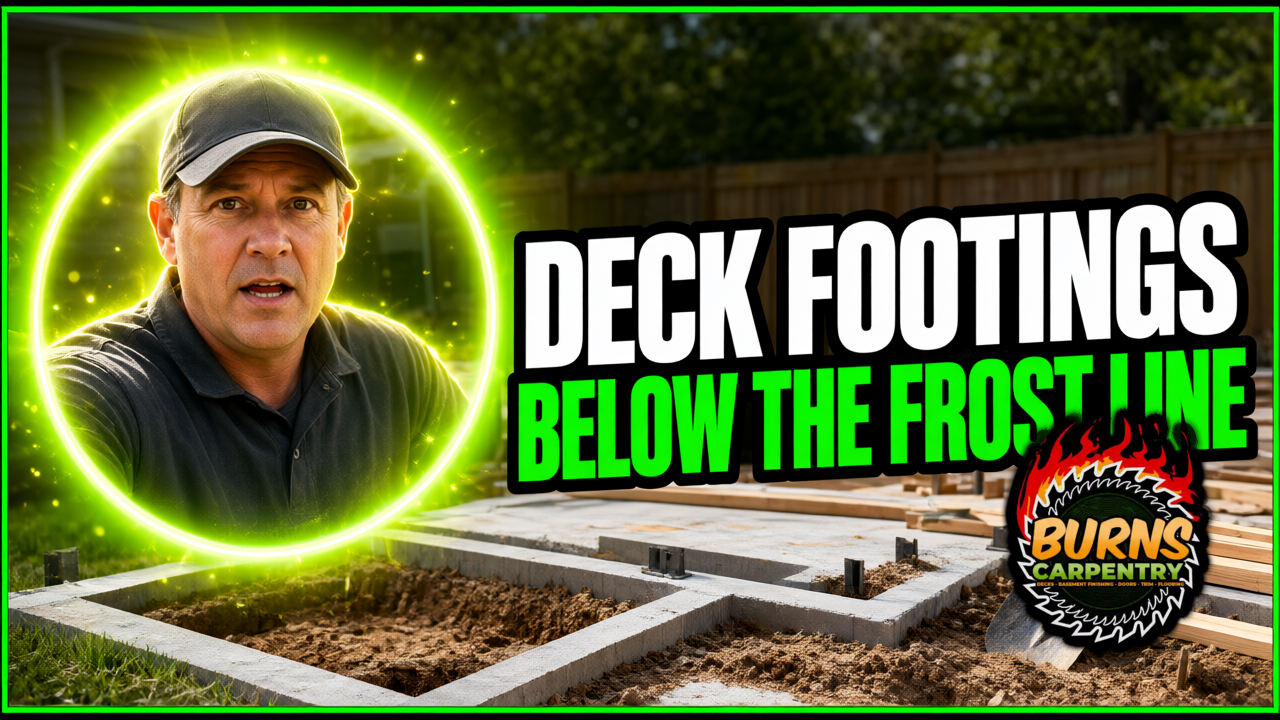
If you are planning Deck Building in Cary, IL, the frost line is the number that decides whether your new deck stays flat for 30 years or heaves two inches every February. Cary sits in McHenry County, where the ground freezes to a depth of about 42 inches, and the Illinois Residential Code requires footings to sit below that line. Skip it, and you are not saving $600 on concrete. You are signing up for a $4,000 to $9,000 repair in five years.
Why Cary's Frost Line Matters for Deck Footings in 2026
Frost heave is not a cosmetic problem. When saturated soil freezes, it expands roughly 9% in volume, and that expansion pushes upward with enough force to lift a concrete footing, crack a post base, and rack a deck frame out of square. In Cary, the frost line sits at 42 inches below grade per the Illinois Residential Code, which means the bottom of every footing has to be at least that deep. Most of the county uses the same number, though inspectors will sometimes ask for 48 inches on an exposed, windblown lot.
Here is the part homeowners miss: the damage shows up months after the pour. A deck built on 24 inch footings can look perfect in July and be visibly out of level by the following March. Once the soil thaws, the footing does not always settle back to where it started. It tips. Then you have a post that is no longer plumb, a beam that is carrying load on one edge, and a ledger pulling away from the house. The repair cost is almost never the footing. It is the framing, the decking, and sometimes the siding where the ledger flashed failed.
Burns Carpentry has been building decks in Cary and the surrounding towns long enough to see the pattern repeat. The decks that fail early are almost always the ones where somebody dug 30 inches and called it close enough. The decks that last are boring. They are over dug, properly inspected, and built with the right concrete mix for our freeze and thaw cycles.

How to Measure Frost Depth for Your Cary, IL Deck Build
The 42 inch number is a minimum, not a target. When Burns Carpentry plans a deck in Cary, the crew digs to 48 inches on the high side of a slope and 42 inches on flat lots, then pours a footing with a widened base. If you are doing the digging yourself or checking a contractor's work, here is the process that matches what a Cary inspector will actually verify.
- Call JULIE at 811 before you dig. It is free, it is legally required in Illinois, and it takes 48 hours for the utility locates to come back. Digging into a gas line or a fiber run is a five figure mistake.
- Find your grade and your slope. Use a laser level or a string line. On a sloped lot, frost depth is measured from the lowest grade line around the footing, not the highest.
- Measure from finished grade, not current grade. If you are adding topsoil or a paver patio around the deck, the footing depth has to account for the final grade, not the dirt you see today.
- Dig to 42 inches minimum, 48 inches on exposed lots. That is below the frost line. Anything less is a heave risk.
- Bell the bottom of the hole. A footing that is wider at the base (typically 12 to 16 inches at the bottom, 8 to 10 inches at the top) resists uplift better than a straight tube.
If you are hiring out the deck building, ask for the footing depth on the plan before the crew shows up. A written plan that says 42 inches or deeper is a good sign. A verbal, "Don't worry, we always go deep enough," is not.
5 Footing Mistakes That Cause Deck Heaving in Cary Winters
Cary winters are not the worst in Illinois, but they are cold enough to punish shortcuts. The last five winters have brought freeze and thaw cycles that rip apart poorly built decks, and the pattern is predictable. These are the mistakes Burns Carpentry sees most often on deck repair calls.
Mistake 1: Digging to 36 inches and calling it done. This is the most common one. It passes a visual inspection. It fails the first hard freeze. The footing lifts, the post base cracks, and by spring the deck is out of level.
Mistake 2: Pouring concrete into a hole full of water. Cary has heavy clay soil that holds water after a rain. If the hole has standing water when you pour, the concrete mixes with mud and never reaches its rated strength. That footing will crumble within a few winters.
Mistake 3: Skipping the gravel base. A 4 to 6 inch layer of compacted gravel under the footing gives water somewhere to drain and keeps the concrete from sitting directly on clay. Skipping it means the footing sits in a bathtub.
Mistake 4: Using the wrong concrete mix. Standard 4,000 psi mix is fine for most decks, but in Cary's freeze and thaw climate, an air entrained mix (5 to 7% air) resists cracking better. Ask what mix is going in the truck.
Mistake 5: Not accounting for the ledger side. The house side of the deck is often overlooked. The ledger has to be flashed and bolted properly, because frost heave on the outer posts combined with a solid ledger is what racks a deck frame out of square.
If your contractor cannot tell you the footing depth, the concrete mix, and the gravel base in one conversation, that is your answer. Move on.

Concrete vs. Helical Piers: Which Footing System Fits Cary Soil
Cary sits on a mix of clay, silt, and in some pockets, shallow bedrock. That soil profile matters when you are choosing between a traditional concrete footing and a helical pier system. Both are legal, both work, and the right answer depends on your lot and your deck design.
Concrete footings are the standard. A 12 inch diameter, 48 inch deep footing with a bell base runs roughly $150 to $300 per footing installed in the Cary area, depending on access and soil. A typical 16 by 20 foot deck needs 9 to 12 footings, so budget $1,800 to $3,600 just for the foundation. Concrete is the right call on flat lots with good drainage and no existing structures in the way.
Helical piers are steel shafts with helical plates that screw into the ground until they hit load bearing soil. They cost more upfront, typically $400 to $700 per pier installed, but they shine on sloped lots, tight access, or where you need to reach deeper than 48 inches to find stable soil. They also do not require curing time, so the deck framing can start the same week. On a lot with a steep grade or a deck that is going over a walkout basement, helical piers often save money on excavation alone.
Here is the honest guidance: most Cary decks do not need helical piers. A standard concrete footing done right will outlast the deck. If a contractor pushes helical piers on a flat lot with no soil issues, ask why. Sometimes the answer is legitimate. Sometimes the answer is a bigger invoice.
Inspection Checklist: What Cary Deck Footing Inspectors Look For
Cary requires a permit for deck construction, and the footing inspection is one of the first stops. The inspector is not there to admire your work. They are checking specific items, and if you know the list ahead of time, the inspection is a 15 minute formality instead of a two week delay.
Here is what gets checked, in the order it usually gets checked:
- Depth below frost line. 42 inches minimum, measured from final grade. The inspector may ask to see the hole before the pour, so do not fill it in early.
- Footing size and bell. Typically 12 inches at the base, wider than the post. A straight sided tube is a red flag.
- Gravel base. 4 to 6 inches of compacted gravel under the concrete.
- Concrete mix. Air entrained, 4,000 psi or better, with a receipt or batch ticket on site.
- Post base hardware. Standoff bases that keep the wood post out of the concrete, so it does not rot from the bottom up.
- Ledger attachment and flashing. Bolted to the house band joist with proper flashing and a water barrier behind it.
- Setback from property lines. Cary has zoning setbacks, typically 5 to 10 feet depending on the lot. Check before you dig.
If you are handling the permit yourself, Burns Carpentry will still walk you through the footing plan, because the footing is the part of the deck that is hardest to fix later. If you hire Burns Carpentry for deck building, the permit process, the footing inspection, and the concrete pour are all handled by the crew, and the workmanship is guaranteed for two years from completion.
Frequently Asked Questions
How deep do deck footings need to be in Cary, IL?
At least 42 inches below final grade, which is the Illinois frost line for McHenry County. On exposed or sloped lots, Burns Carpentry digs to 48 inches to be safe. Anything shallower risks frost heave.
How much does a deck footing cost in Cary?
Plan on $150 to $300 per concrete footing installed, or $400 to $700 per helical pier. A standard 16 by 20 foot deck needs 9 to 12 footings, so the foundation alone typically runs $1,800 to $3,600.
Do I need a permit for a deck in Cary, IL?
Yes. Cary requires a permit for deck construction, and the footing inspection is part of the process. Burns Carpentry handles the permit application and inspection scheduling for deck building projects in Cary.
Can I build a deck in Cary in the winter?
Yes, but the footing pour needs to be protected from freezing. Concrete cures best above 40 degrees Fahrenheit, so winter pours need insulated blankets or a heated enclosure. Most Cary deck builds happen between April and November for that reason.
If you are planning a deck in Cary and you want the footing done right the first time, Burns Carpentry builds decks across Cary, Arlington Heights, Elgin, and the surrounding towns. The crew handles the permit, the footing inspection, and the pour, and every project carries a two year workmanship guarantee. Call for a free estimate and ask them to walk you through the footing plan before anything gets dug.