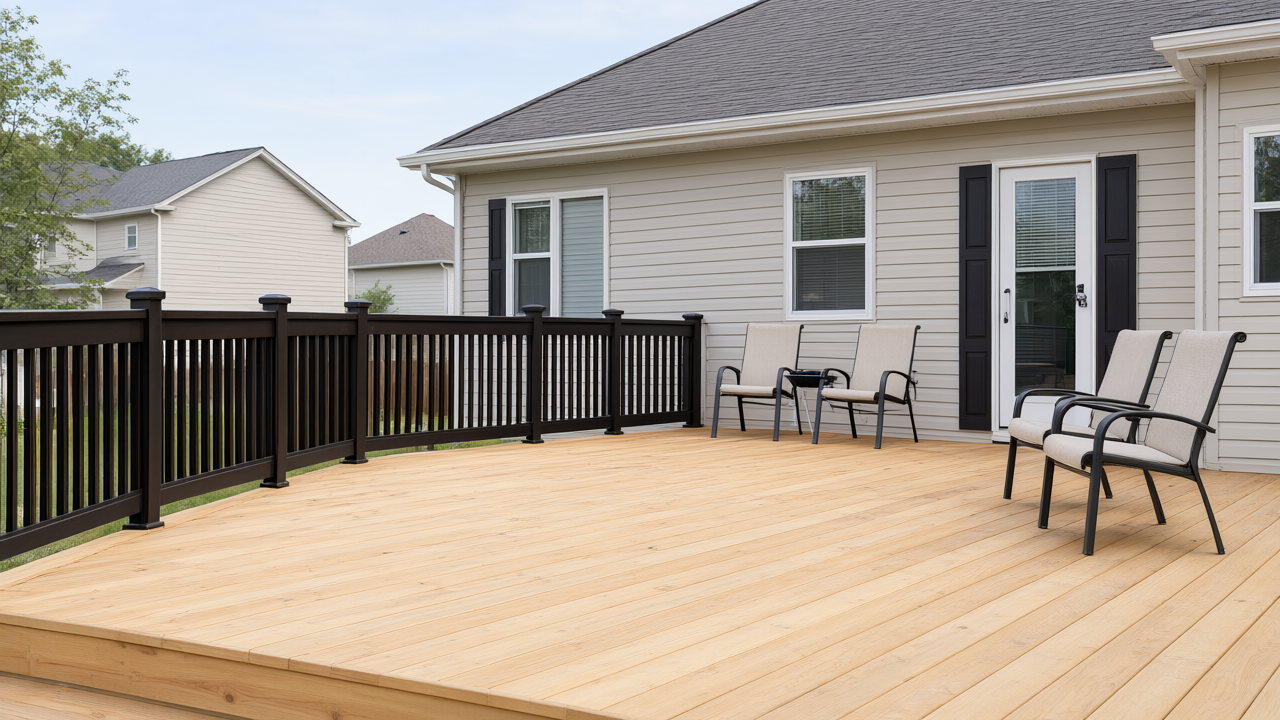
Deck board spacing is one of those details that looks trivial until it isn't. In Cary, IL, where we see temperature swings from 90 degree summer afternoons to below zero January nights, the quarter inch gap between your deck boards is doing more work than you might think. Homeowners who nail this detail get decks that last 25 years or more. Those who skip it often find themselves calling for Deck Repairs inside of a decade.
Why Deck Board Spacing Matters for Drainage and Airflow in Cary's Climate
The primary job of that gap between boards is water management. When rain hits your deck, and Cary gets about 38 inches of it annually, that water needs somewhere to go. Proper spacing lets water fall through the gaps instead of pooling on the surface. Pooled water on a wood deck doesn't just create a slippery hazard after a storm. It soaks into the end grain of the boards, which is exactly where rot starts. Over a few seasons, that trapped moisture turns into cupped boards, split edges, and eventually structural decay that a deck repair crew has to address.
Airflow is the second job, and it matters more than most people realize. Those gaps allow air to circulate under and around each board, which means the underside of your deck can actually dry out between rain events. This is especially critical in Illinois, where our humidity sits above 70 percent for much of the summer. Without airflow, moisture gets trapped between the joists and the decking, creating a micro climate that invites mold, mildew, and rot. A properly spaced deck dries out within hours of a rainstorm. A tightly packed deck can stay damp for days.
The third reason spacing matters might surprise you. Wood is a living material that expands and contracts with humidity changes. In Cary, the difference between a dry February day at 20 percent humidity and a humid July afternoon at 85 percent can change the width of a six inch deck board by nearly an eighth of an inch. If boards are installed with no gap, they have nowhere to go when they expand. That pressure pushes boards up, causing the buckling and crowning that ruins the look of an otherwise beautiful deck.

Standard Spacing Guidelines for Wood and Composite Decks
For traditional pressure treated lumber and cedar decking, the standard gap is 1/8 inch when the wood is properly dried. This spacing accounts for the natural expansion that happens when the boards absorb moisture. A 1/8 inch gap means that even at peak summer humidity, the boards won't touch each other, which prevents the compression damage that leads to buckling. In Cary, where our freeze thaw cycles put extra stress on outdoor structures, this standard gap is the difference between a deck that stays flat and one that develops waves.
Composite decking, like the materials Burns Carpentry uses in our Preferred Composite Deck Package, follows different rules. Most composite manufacturers specify a gap of 1/4 inch for their products. This is because composite boards expand and contract more dramatically with temperature changes than wood does. On a hot July day in Chicago, composite decking can expand significantly. If the 1/4 inch spacing isn't there, the boards can push against each other and the fasteners, causing them to pop or the boards to warp. Always check the manufacturer's specific recommendation, as some brands require up to 3/8 inch spacing for darker colors that absorb more heat.
There's also a spacing consideration at the edges of your deck. Most building codes in McHenry County require a minimum of 1/8 inch between the house and the deck structure, and proper clearance between the deck frame and any adjacent walls. These gaps allow for drainage behind the ledger board and prevent moisture from getting trapped against your home's siding. A good contractor builds these clearances into the design from day one, not as an afterthought.
Common Mistakes Homeowners Make with Deck Board Spacing
The most common mistake we see in Cary is the zero gap install. Homeowners or inexperienced contractors butt boards tightly together because it looks clean and modern when the deck is first built. That pristine look lasts exactly one season. By the following spring, the boards have absorbed moisture, expanded, and started to cup at the edges. Within two years, you're looking at a deck surface that has lifted nails, uneven boards, and water pooling in low spots. The irony is that the tight gap which looked so good at installation is exactly what destroys the deck's appearance and structure.
The second mistake is inconsistent spacing. We've seen decks where the gap varies from a sliver to almost half an inch across the same row of boards. This usually happens when someone uses a single nail or screw as a spacer and moves it around, or when they eyeball the gaps instead of using a consistent tool. Uneven spacing doesn't just look sloppy. It creates areas where water drains quickly and areas where it lingers, which means some boards dry out while others stay wet. That inconsistent moisture exposure leads to uneven weathering and premature replacement of specific boards.
The third mistake is using the wrong fasteners with your spacing. If you're using hidden fasteners, the spacing is built into the clip system. That's usually fine. But if you're face screwing boards, the temptation is to pull the boards tight as you drive the screw, which closes the gap you just created. The fix is simple. Use a spacer, drive the screw, then remove the spacer. And never, ever use a nail gun to secure deck boards. Nails work themselves loose with expansion and contraction, which is why you see popped nail heads all over older Cary decks. Screws hold the boards down so the wood expands and contracts across its width, not up off the joists.

How to Measure and Maintain Proper Spacing on Your Deck
If you're building a new deck or replacing worn boards on an existing one, here's the exact process our crew uses on every Burns Carpentry Deck Building project in Cary. First, dry the boards completely before installation. Wet boards will shrink as they dry, which means the gaps you create at installation will widen over the first few months. Second, use a consistent spacer. A 1/8 inch spacer for wood or a 1/4 inch spacer for composite. We use a simple piece of plywood cut to the exact width, or a commercial deck spacer tool. The tool costs about $15 at any hardware store and pays for itself in one row of boards.
Maintenance is just as important as the initial install. Once a year, usually in the spring before the summer rains hit, walk your deck and check the gaps. Look for boards that have shifted, gaps that have closed up, or areas where debris like leaves and pine needles have collected. That organic material holds moisture against the boards and accelerates rot. A quick sweep or a leaf blower to clear the gaps is one of the cheapest deck maintenance tasks you can do, and it dramatically extends the life of your deck.
If you notice boards that have buckled or cupped despite proper spacing, that's a sign of a deeper issue, often with the joists or flashing underneath. At that point, a simple spacing fix isn't the answer. You need a professional deck inspection to check the structural integrity of the frame before you invest in new decking.
When to Call a Professional in Cary, IL
There's a lot of deck work you can handle yourself. Replacing a single board, adjusting a gap that's closed up, or adding a spacer where one was missed are all DIY friendly projects that take an afternoon. If you're comfortable with a circular saw and a drill, and you understand the basic principles of expansion and drainage, you can maintain your deck's spacing without calling anyone.
But there are situations where professional help is the smarter move. If your deck is more than 15 years old and you're noticing widespread cupping, popped nails, or boards that have started to rot at the ends, you're past the point of a simple fix. Those symptoms indicate that the decking has reached the end of its life, and possibly the framing underneath has been compromised by years of moisture exposure. Replacing decking without checking the frame is putting new material on potentially rotten bones. That's when a complete Deck Repairs assessment from a qualified carpenter is worth every penny.
If you're building a new deck from scratch, the spacing is just one of dozens of details that need to be right. The framing, the flashing, the footings, the ledger attachment, and the railing all have their own critical specifications. A mistake in any of them can compromise the entire structure. For a project of that scale, most Cary homeowners find that hiring a professional deck building company is both faster and safer than a DIY build. The cost of a professionally built deck in the Chicago suburbs typically runs $40 to $60 per square foot for wood and $60 to $90 per square foot for composite, but you're paying for the confidence that every detail, including the spacing, is done right.
Burns Carpentry handles deck building and deck repairs throughout Cary, Arlington Heights, Aurora, Chicago, Elgin, Joliet, Naperville, Palatine, Schaumburg, and Waukegan. Our team understands the specific demands of the Illinois climate, from the freeze thaw cycles that stress fasteners to the humidity that tests every gap. We build decks with the right spacing, the right materials, and the right structural details for our weather.
Frequently Asked Questions
What is the correct deck board spacing for composite decking?
Most composite decking manufacturers recommend a 1/4 inch gap between boards. This allows for the thermal expansion that happens when composite materials heat up in direct summer sun. Always check the specific brand's installation guide, as some products and darker colors require up to 3/8 inch.
Can I fix deck board spacing on my existing deck?
Yes, if only a few boards are affected. You can remove the boards, clean the joists, and reinstall them with proper spacers. However, if many boards are cupped or buckled, it usually means the decking is at the end of its life and a full replacement is more economical.
How much does it cost to replace deck boards in Cary?
Replacing individual boards costs about $5 to $10 per board for materials if you do it yourself. Hiring a professional for a full re-decking project typically runs $15 to $25 per square foot for labor and materials, depending on whether you choose wood or composite.
Does Burns Carpentry handle deck repairs in Cary?
Yes, Burns Carpentry provides professional deck repair services across Cary and the surrounding Chicago area. We inspect the entire structure, not just the visible decking, to identify any underlying issues with the frame or flashing before recommending a course of action.
If your deck is showing signs of spacing problems, or if you're planning a new build and want it done right the first time, Burns Carpentry can help. We offer free estimates for deck building and deck repair projects across Cary and the greater Chicago area. Give Andy a call and get a straight answer about what your deck actually needs.