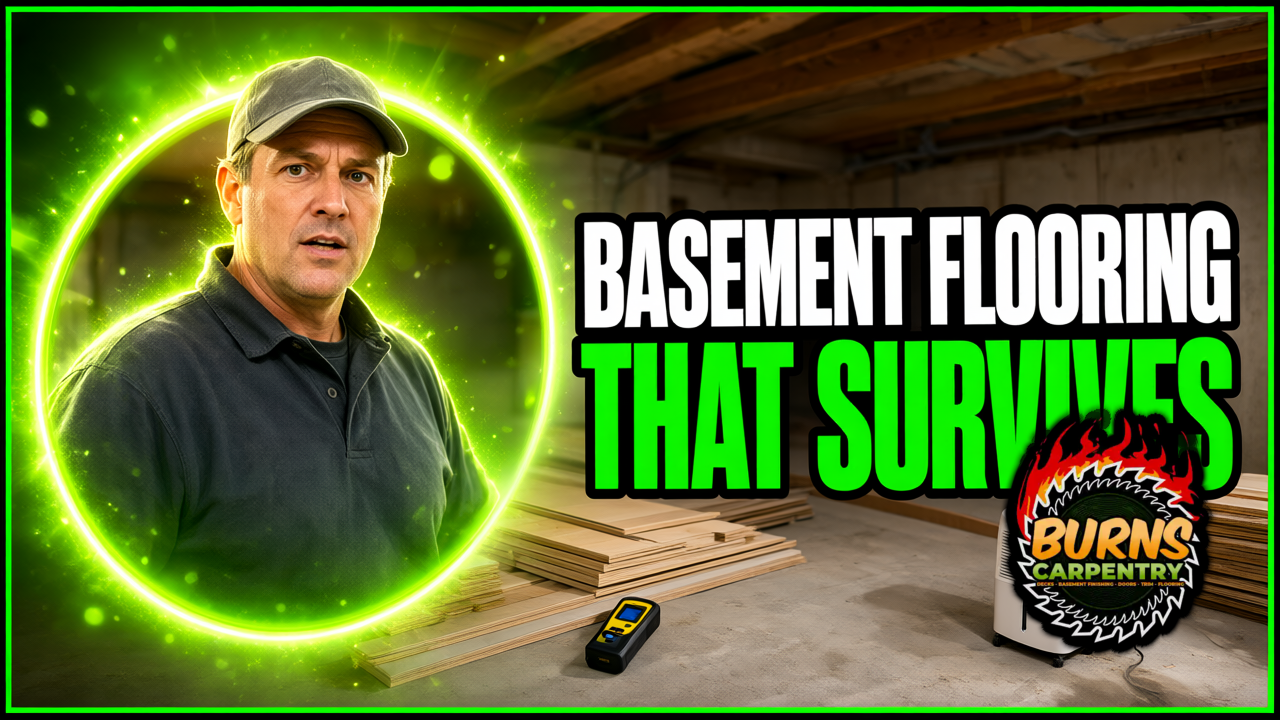
If you are pricing out Palatine basement flooring, the number that matters is not the cost per square foot on the box. It is the cost per square foot that survives a July thunderstorm. Palatine sits on the edge of the Des Plaines River watershed, and thousands of homes here were built between 1955 and 1985 with basements that were never designed to stay bone dry. That single fact reshapes every flooring decision you make below grade, and it is why the same laminate that works beautifully in an Aurora living room can cup, buckle, and grow a science experiment under a Palatine rec room rug within 18 months. Here is what actually holds up, what it costs in 2026, and how to prep a slab so your new floor is still flat in 2036.
Palatine Basement Moisture: Why It Changes Your Flooring Choices
Basement moisture in Palatine comes from three places, and they behave differently. Hydrostatic pressure pushes groundwater up through the concrete slab after a heavy rain, which is why the northwest corner of a basement often feels damp while the southeast corner stays dry. Humid summer air condenses on cool slab surfaces, which is why a basement can hit 65% relative humidity in July without a single drop of standing water. And bulk water intrusion, usually from a failed window well, a cracked cove joint, or a downspout dumping next to the foundation, shows up as a wet perimeter after storms.
Concrete slabs transmit moisture vapor continuously, even when the surface looks and feels dry. The industry measures this as pounds of water vapor per 1,000 square feet per 24 hours, and the standard test is a calcium chloride kit or an in situ relative humidity probe. Most wood based flooring manufacturers want readings at or below 3 pounds and 75% RH. Plenty of Palatine slabs test at 5 to 8 pounds, especially in homes near Salt Creek and in the older neighborhoods off Northwest Highway. If you skip that test and glue down laminate anyway, you have purchased a very expensive moisture meter.
This is why the honest answer to "what flooring should I put in my basement" starts with a moisture assessment, not a product catalog. Burns Carpentry builds moisture control into every Basement Finishing project for exactly this reason, starting with a slab assessment before a single plank gets ordered. If your basement has active seepage, visible efflorescence (that white chalky powder on the concrete), or a musty smell that returns after you run a dehumidifier for a week, fix the water first. No flooring product on the market is a substitute for a working sump, a properly sloped grade, and sealed window wells. Spending $2,500 on drainage before spending $6,000 on flooring is the right order of operations.
Laminate vs. Vinyl in Palatine Basements: 2026 Cost & Durability Comparison
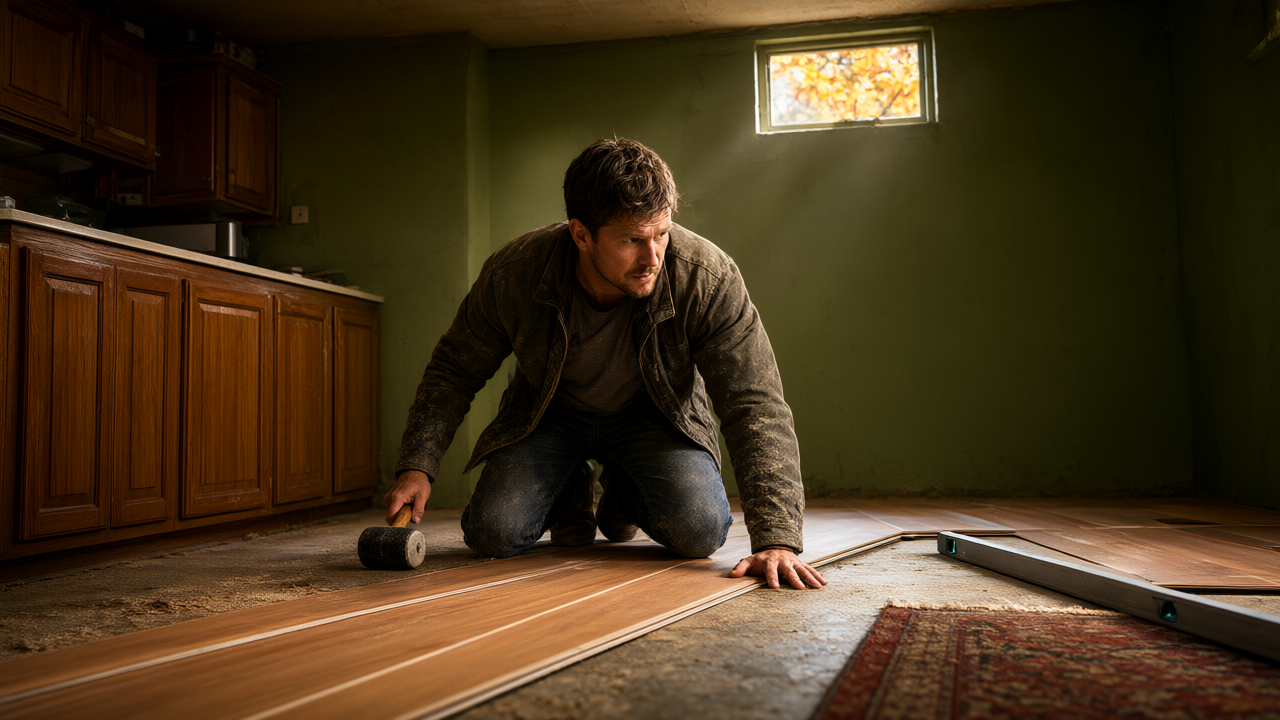
Both laminate and vinyl have changed dramatically in the last five years, and the old advice ("never put laminate in a basement") is now half wrong. Modern laminate cores are denser and some lines carry legitimate moisture warranties. But the fundamental difference remains: laminate has a wood or fiber composite core that swells when water reaches it, and vinyl is plastic through and through.
Here is how the two compare for a Palatine basement in 2026, installed:
- Laminate: Typically $4.50 to $8.50 per square foot installed in the Palatine area, including underlayment and standard trim. Looks the most like real hardwood. Handles humidity swings fine. Handles a flooded carpet style event badly, and once the core swells, the plank is unrecoverable.
- Luxury vinyl plank (LVP): Typically $5.50 to $10.50 per square foot installed. Waterproof core, comfortable underfoot, and the better grades have convincing texture. Sits closer to the slab, so it tolerates minor flatness variation better than laminate. Can be installed floating or glued down.
- Luxury vinyl tile (LVT): Typically $6 to $11 per square foot installed. The best choice if you want a stone or tile look without the cold, hard feel of actual ceramic. Grout line options have gotten genuinely good.
The durability question comes down to what kind of risk you are underwriting. If your basement has never taken on water and your moisture test comes back clean, laminate is a perfectly reasonable choice and saves you a few hundred dollars on a 600 square foot room. If your basement has flooded once in the last decade, or sits in a low pocket where the sump runs every spring, vinyl is not an upgrade, it is insurance. A flooded laminate floor is a total replacement. A flooded LVP floor is a shop vac, a fan, and a Saturday afternoon.
One more thing worth knowing: wear layers matter more than brand names. Look for a wear layer of at least 12 mil for a basement that gets real traffic, and 20 mil if you have dogs. A 6 mil wear layer on a $3.49 per square foot special is going to look like a skating rink in three years, and the labor to replace it costs more than the material did.
Professional Carpentry Installation: Subfloor Prep, Leveling & Timeline
The dirty secret of basement flooring is that the installation is the easy part. The prep is where floors succeed or fail, and it is the part every cheap quote skips. A concrete slab in a 1960s Palatine ranch is rarely flat to within a quarter inch over 10 feet, which is the tolerance most floating floor manufacturers require. It might slope 3 inches across the room toward a floor drain. It might have a high spot from a patched sewer line and a low spot where the old carpet pad compressed the slab.
Here is the actual sequence a competent crew follows, and the sequence you should demand in writing:
- Moisture test. Calcium chloride or in situ RH probe, results documented in writing. Not a plastic sheet taped to the floor for a day.
- Slab cleaning and crack repair. Grind off old adhesive, patch cracks and control joints with a hydraulic cement or epoxy filler.
- Flatness check. A 10 foot straightedge walked in a grid pattern, high spots ground down, low spots filled with self leveling compound.
- Moisture barrier. A 6 mil or heavier polyethylene vapor barrier, lapped 6 inches at seams and taped. Some vinyl products have the barrier attached to the back; confirm which one you are buying.
- Underlayment and acclimation. Laminate needs 48 hours to acclimate in the room. Vinyl typically needs less, but the box will tell you.
- Layout and install. Stagger joints, leave the manufacturer's expansion gap at every wall, and undercut door jambs rather than trying to trim around them.
- Trim, transitions, and thresholds. Base shoe or new baseboard, reducer strips at doorways, and a clean transition to any existing stair treads.
Timeline for a typical 500 to 700 square foot Palatine basement: three to five working days for a clean slab, and five to seven if significant leveling is required. Self leveling compound needs to cure, and rushing it is how you get a floor that telegraphs every imperfection within a year. Your home stays usable throughout. The crew will move furniture, work room by room if needed, and keep a path to the stairs clear. If a contractor tells you they can do a full basement in one day including leveling, they are either not leveling or not sleeping.
5 Flooring Mistakes Palatine Homeowners Make in Finished Basements
After enough basement projects in Palatine and the surrounding northwest suburbs, the same five mistakes show up over and over. Every one of them is avoidable, and every one of them costs real money to undo.
- Skipping the moisture test because the basement "feels dry." Concrete can look and feel dry while moving 6 pounds of vapor per 1,000 square feet per day. The test costs under $100 and takes 24 to 72 hours. Skipping it is how a $7,000 floor becomes a $7,000 floor plus a $2,000 remediation.
- Buying the cheapest wear layer. A 6 mil wear layer on clearance is a false economy. At 12 mil minimum, you get a floor that survives 10 years of kids, dogs, and a home gym.
- Installing over a slab that has not been leveled. Floating floors need flat, not level. A slope is fine. A 3/8 inch hump in the middle of the room is not, and it will show as a visible ridge and a clicking seam within months.
- Ignoring the stair transition. Basement stairs are the hardest part of the job and the most visible. Plan the transition from day one, whether that means new treads, a matching nosing, or a deliberate contrast.
- Forgetting the dehumidifier. A $250 dehumidifier set to 50% RH is the single best investment you can make in a finished basement. It protects the floor, the drywall, the furniture, and the air quality. Run it from April through October without exception.
Here is the part most contractors will not tell you: if your basement is a true utility space you use for storage and laundry, with a rough slab and no intention of finishing it, you do not need a professional Flooring Installation at all. A coat of concrete sealer and a couple of rubber mats will serve you fine for a fraction of the cost. Save the flooring budget for the rooms you actually live in.
How to Budget for Basement Flooring Installation in Palatine (2026)
Realistic 2026 numbers for a Palatine basement, all in, including materials, labor, basic trim, and standard prep:
- 400 square feet, laminate, clean slab: $2,200 to $3,400
- 600 square feet, laminate, clean slab: $3,000 to $5,100
- 600 square feet, luxury vinyl plank, clean slab: $3,600 to $6,300
- 600 square feet, LVP with significant leveling: add $800 to $2,000 for self leveling compound and labor
- Moisture testing: $75 to $200, and worth every dollar
- Stair treads and nosing: $150 to $400 per step depending on material and whether you are matching existing stairs
Two budget items people forget. First, moving furniture and clearing the space is either your weekend or a line item, and it is not free either way. Second, permits. A straight flooring swap usually does not require one, but a basement finishing or remodeling project that includes framing, electrical, or plumbing does. Burns Carpentry handles the permit process with Palatine's building department as part of basement finishing work, which matters because unpermitted work can complicate a future sale.
One honest note on timing: if you are reading this in October, you have a window. Basement projects scheduled in late fall and winter get done faster because the outdoor deck and pergola work that fills summer calendars has slowed down. If you want your basement floor done before the holidays, get the moisture test scheduled in the next two to three weeks.
Frequently Asked Questions
How much does basement flooring installation cost in Palatine?
Expect $5 to $10 per square foot installed for most Palatine basements in 2026, which puts a typical 600 square foot finished basement between $3,000 and $6,000. Laminate lands at the lower end, luxury vinyl plank and tile at the upper end. Add $800 to $2,000 if the slab needs significant leveling.
Is laminate or vinyl better for a basement?
Vinyl is the safer choice if your basement has any history of water. It is waterproof through the core, so a minor flood means drying it out rather than replacing it. Laminate is fine and often looks better if your slab tests dry and your drainage is solid. Run the moisture test before you decide.
How long does it take to install flooring in a basement?
A typical Palatine basement takes three to five working days from prep through final trim. Add a day or two if self leveling compound is needed, since it has to cure. Your home stays usable the entire time.
Do I need a professional for basement flooring, or can I DIY it?
You can DIY a floating vinyl plank floor over a flat, dry slab, and plenty of homeowners do it successfully. Hire a professional when the slab needs leveling, when moisture readings are elevated, when you are dealing with stairs and transitions, or when the basement is part of a larger finishing project. Those are the situations where a mistake is expensive to reverse.
If you are in Palatine and your basement slab is anything other than perfectly flat and dry, this is the kind of work Burns Carpentry handles every week. Andy Burns and the crew do basement finishing, Basement Remodeling, and flooring installation across Palatine, Arlington Heights, Schaumburg, and the surrounding suburbs. They will test the slab, tell you straight whether you need leveling or drainage work first, and give you a written estimate before anything starts. Call them, ask for the moisture test results in writing, and get a number you can actually budget against.