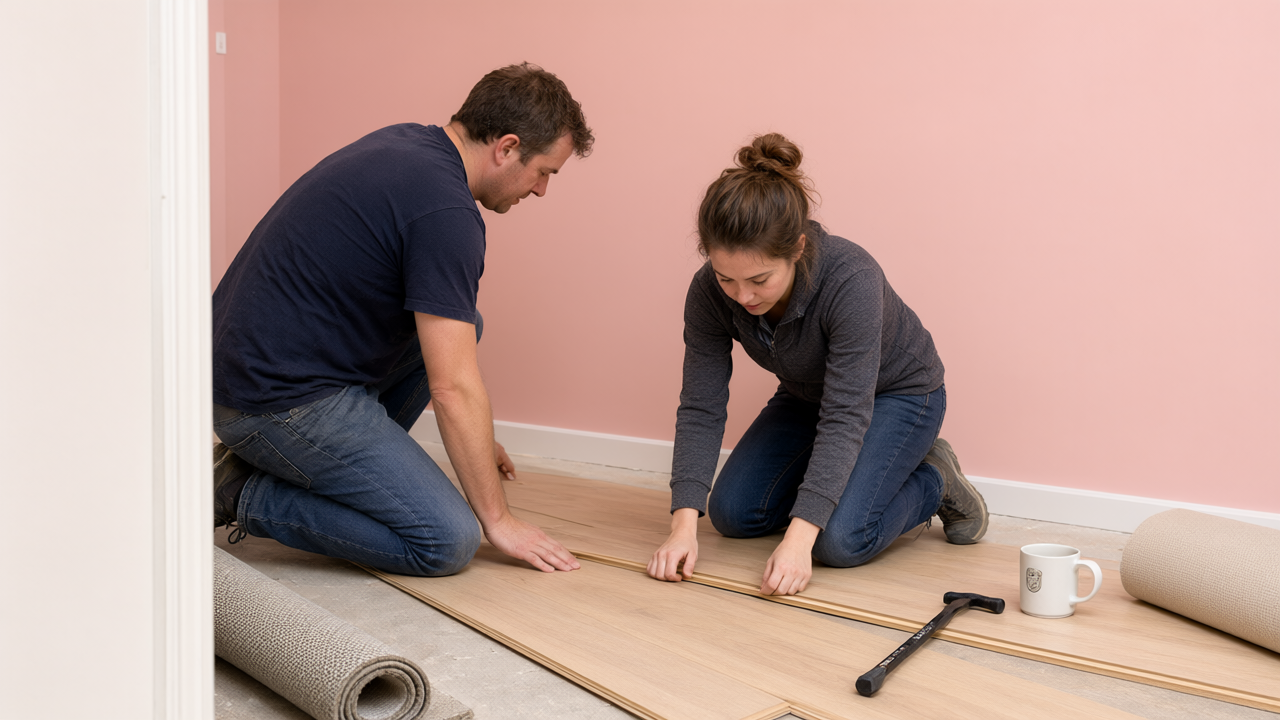
If you're budgeting for laminate Flooring Installation in Cary, Illinois, and you've simply multiplied the room's square footage by the box price, you're already off by 25% to 40%. The real sticker shock for homeowners in 2026 doesn't come from the planks themselves, but from the five hidden costs that even detailed online calculators miss. These are the line items that turn a $3,500 material estimate into a $5,200 final bill, and they're especially common in Cary's mix of charming older homes and newer subdivisions.
The True Cost of Subfloor Prep in Cary's Older Homes
This is the single biggest budget killer we see at Burns Carpentry, and it's almost never in the initial quote. Laminate Flooring requires a subfloor that is flat, level, dry, and structurally sound. In a new construction home, that's a given. In Cary, where many homes in the historic downtown area or established neighborhoods like Foxford Hills were built in the 70s and 80s, it's a gamble.
The problem isn't just an uneven plywood subfloor. It's often multiple layers of old flooring. A typical scenario in a Cary split level might reveal: original 3/4" hardwood nailed down, a layer of 1/4" particle board from a 1990s update, and then sheet vinyl glued on top. To install new laminate correctly, all of that must be removed down to the original subfloor. That's not just demo labor, it's disposal fees for heavy, bulky materials. We've seen this prep work alone add $2 to $4 per square foot to a project.
Then comes leveling. Concrete slabs in basements or sunken family rooms often have cracks, slopes, or high spots. Wood subfloors can have significant dips between joists. Using a self leveling compound is the fix, but it's a precise, messy process. For a 400 square foot room, the material cost for compound is $150 to $300, and the skilled labor to pour and feather it correctly adds another $400 to $600. Skipping this step guarantees noisy, bouncy floors and premature locking system failure. A proper installer will always check subfloor conditions with a 6 foot level and laser before giving you a firm price.

Waste Factor & Material Overages: Why Your Square Footage Estimate Is Wrong
You measured your room at 300 square feet. The laminate box says it covers 24 square feet. You need 12.5 boxes, so you buy 13. This math will leave you short almost every time. Professional installers calculate with a waste factor, typically 7% to 10% for simple, rectangular rooms. For complex layouts with hallways, closets, or lots of corners, that factor jumps to 15% or more.
Waste comes from three places. First, cutting planks to fit at walls and around doorways. You can't use the leftover 6 inch piece from one row to start the next, because the locking system requires staggered seams. That scrap is waste. Second, you must account for pattern matching and color lot consistency. If you run out and buy more boxes from a different dye lot, the color shift can be dramatic. Buying all your material at once from the same production run is non negotiable. Third, and most critical, is having spare planks for future repairs. Pets, dropped pans, and moving furniture can damage laminate. If your exact product is discontinued in two years (a common occurrence), you'll have no way to patch it. A responsible installer will recommend you keep 5% of your material, unopened, in storage.
For that 300 square foot room, a 10% waste factor means you actually need material for 330 square feet. That's 14 boxes, not 13. At $50 per box, that's an extra $50 you didn't budget for. For a whole house installation, this oversight can mean a surprise $300 to $500 material upcharge at the register.
Transition Strips & Moldings: The 'Finishing Touch' Budget Buster
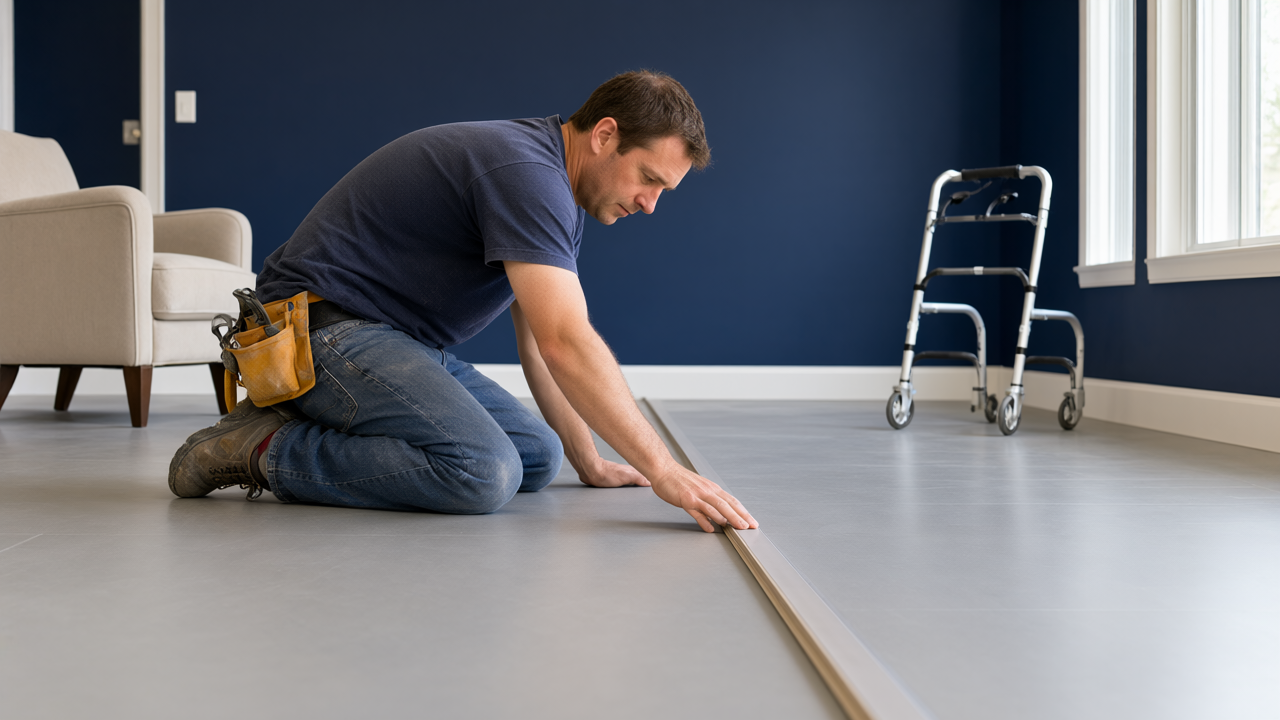
Laminate planks are the main course, but transition strips and moldings are the necessary side dishes you forgot to order. These pieces are sold separately, often at a shockingly high price per linear foot. You'll need them anywhere the new laminate meets a different flooring surface, like at a bathroom tile threshold or a carpeted bedroom hallway. You'll also need them to cover the expansion gap around the entire perimeter of the room, which is hidden by baseboard or quarter round molding.
Let's break down a real example for a Cary home where laminate is being installed in a living room and kitchen, meeting a tiled foyer and a carpeted hallway. You'll need: a T mold transition for the hallway (about $35 for a 4 foot piece), a reducer strip for the tile step down (about $30), and quarter round to cover gaps along all walls (about $1.50 per linear foot). For a room with 120 linear feet of wall, that's $180 in quarter round alone, plus installation. Specialty pieces, like stair noses for steps down into a sunken living room or end caps for fireplaces, can cost $50 to $100 each. These items are rarely included in a basic "per square foot" installation quote.
A red flag to watch for is a quote that says "moldings and transitions included" without specifying the type or amount. It often means they'll use the cheapest, most basic options. For a polished look that matches your plank color and style, specify these details upfront. At Burns Carpentry, we itemize every transition and molding in our laminate flooring proposals so there are no surprises when the finishing touches go on.

Furniture Moving & Disposal Fees: The Labor Costs You Forgot
Many homeowners assume that moving furniture is their responsibility, or that it's a trivial part of the job. In reality, it's a significant labor cost and a point of liability. A professional crew can move the contents of a standard living room in about 30 to 45 minutes. But if you have a grand piano, a 500 pound antique china cabinet, or a complex home theater system, that time multiplies. Some companies explicitly exclude moving electronics, aquariums, or grand pianos from their standard rate.
Then there's disposal. What happens to your old flooring? Carpet and pad are bulky. Old vinyl sheet goods are heavy. Nail down hardwood creates a massive pile of splintered wood. Most municipal waste services in McHenry County have limits on how much construction debris they'll take. For a full house job, you're likely looking at a dedicated dumpster rental or multiple trips to the landfill. A 10 yard dumpster in Cary costs $400 to $550 for a week, plus landfill fees which are often calculated by weight. This cost is almost never in an online estimator.
Here's our insider advice: if you want to save money, handle the furniture moving and old floor disposal yourself. But you must do it completely. That means every room is empty, every closet is cleared, and the old material is already at the curb or gone before the installers arrive. If the crew shows up and has to spend two hours moving your bookcases and disconnecting your TV, expect a bill for that time at their standard hourly rate, which in 2026 ranges from $85 to $120 per hour per man in the Cary area.
How to Get an Accurate Laminate Flooring Quote in Cary, IL
Now that you know the hidden costs, you can avoid them by knowing exactly what to ask for. A vague quote is a dangerous quote. Follow this checklist when getting estimates for your laminate flooring installation.
- Demand a Site Visit: Never accept a quote over the phone or based on your measurements. A reputable professional from Burns Carpentry or any quality contractor will insist on seeing the space. They need to check subfloor conditions, door clearances, and layout complexity.
- Ask for a Line Item Quote: The estimate should clearly separate material costs, labor for installation, labor for prep/demo, and the cost of all ancillary items. Look for these specific lines: Laminate Planks (with brand, style, and square footage including waste factor), Underlayment (type and thickness), Self Leveling Compound (if needed), Transition Strips/Moldings (type and linear footage), Furniture Moving (yes/no and any exclusions), Old Material Removal & Disposal, and any permit fees if the work is part of a larger remodel.
- Verify What's NOT Included: Ask directly: "Does this price include moving all furniture, disconnecting and reconnecting appliances like the refrigerator and dishwasher, removing and replacing toilet bases if we're doing a bathroom, or repairing any subfloor issues we discover?"
- Get Timeline Details in Writing: How many days will the job take? What time does the crew start? Will your home be usable (e.g., can you access the kitchen or a bathroom)? Who is the point of contact if you have a question?
- Check Credentials for Cary: Confirm the company is licensed and insured to work in Illinois and specifically in Cary. Ask for proof of insurance. Burns Carpentry, for instance, carries comprehensive liability and workers' compensation coverage, which protects you if anything goes wrong.
When don't you need a professional? If you're installing laminate in a single, small, perfectly square room with a concrete slab subfloor that you've verified is level, and you're confident in your ability to handle a tapping block, pull bar, and undercut saw, a DIY approach can save money. But for whole houses, complex layouts, or any home built before 1990 in Cary, the risk of costly mistakes is high. The locking systems on modern laminate are unforgiving; a poorly installed section can telegraph through the entire floor.
Frequently Asked Questions
How much does laminate flooring installation cost in Cary, IL?
For a standard professional installation in 2026, expect to pay between $6.50 and $11.50 per square foot in the Cary area. This wide range accounts for material quality (basic laminate vs. premium waterproof styles) and the prep work needed. A simple install over an existing flat floor might be at the lower end, while a job requiring extensive subfloor leveling and old floor removal will hit the higher end.
How long does a typical laminate flooring installation take?
For a professional crew like ours at Burns Carpentry, a typical single room (300 400 square feet) takes one to two days, including furniture moving and prep. A whole house installation (1,500 2,000 square feet) typically takes three to five days. The timeline depends heavily on subfloor conditions and the complexity of the layout around cabinetry and doorways.
What should I look for when choosing a laminate flooring installer?
Look for detailed, line item quotes, not just a single price per square foot. Ask about their waste factor calculation and if they include a few boxes of extra material for you. Check online reviews specifically for communication and cleanup. Most importantly, verify they are licensed and insured. Any reputable installer in Illinois should provide this information willingly.
Can I install laminate flooring over my existing tile or vinyl?
Sometimes, but it's risky. You can only install over existing hard surface flooring if it is perfectly flat, firmly attached, and moisture free. Grout lines in tile must be filled, and any vinyl must be non cushioned. In most cases, especially in older Cary homes, it's better to remove the old material to ensure a proper, long lasting installation and to avoid height transition issues at doorways.
If the math on your laminate flooring project is starting to look more complex than you anticipated, especially in an older Cary home, it's worth getting a professional opinion. Burns Carpentry provides detailed, transparent estimates for laminate flooring that account for subfloor prep, waste, and all finishing touches. We'll tell you straight up what's necessary and what you can skip, so you can budget with confidence. Give us a call to schedule a free, on site assessment of your space.