Waukegan sits right on Lake Michigan, and that lakefront location is brutal on basements. The average relative humidity in Waukegan hovers between 72% and 78% from May through October, which is roughly 10 to 15 points higher than inland towns like Cary or Palatine. That extra moisture pushes through concrete block walls, condenses on cold floor slabs, and finds every gap in a framing job. If you're planning Basement Finishing in Waukegan in 2026, five moisture mistakes will turn a $35,000 investment into a moldy, warped headache within two summers. Here's what to avoid, and what to do instead.
Why Waukegan's Lakefront Humidity Makes Basement Moisture Control Non-Negotiable
Basements in Waukegan deal with two moisture sources that inland basements don't: lake-effect humidity and a water table that rises after heavy spring rain. The city's older housing stock, much of it built between 1920 and 1970, sits on poured concrete or block foundations that were never designed with modern waterproofing in mind. When warm, damp lake air hits a 55°F foundation wall, condensation forms. That's not a leak. That's physics.
The problem is most finishing crews treat moisture control as an afterthought. They frame walls tight to the concrete, install fiberglass batt insulation, hang drywall, and call it done. Then the homeowner notices a musty smell in August and a soft spot in the drywall by October. By the time mold is visible, the repair bill typically runs $4,000 to $9,000 just to tear out and redo the affected area, before you even address the water source.
A properly finished Waukegan basement keeps the concrete wall exposed to interior air, uses rigid foam insulation with sealed joints, and gives water a path to drain rather than a place to hide. That single design choice separates basements that last 20 years from basements that need remediation in three.
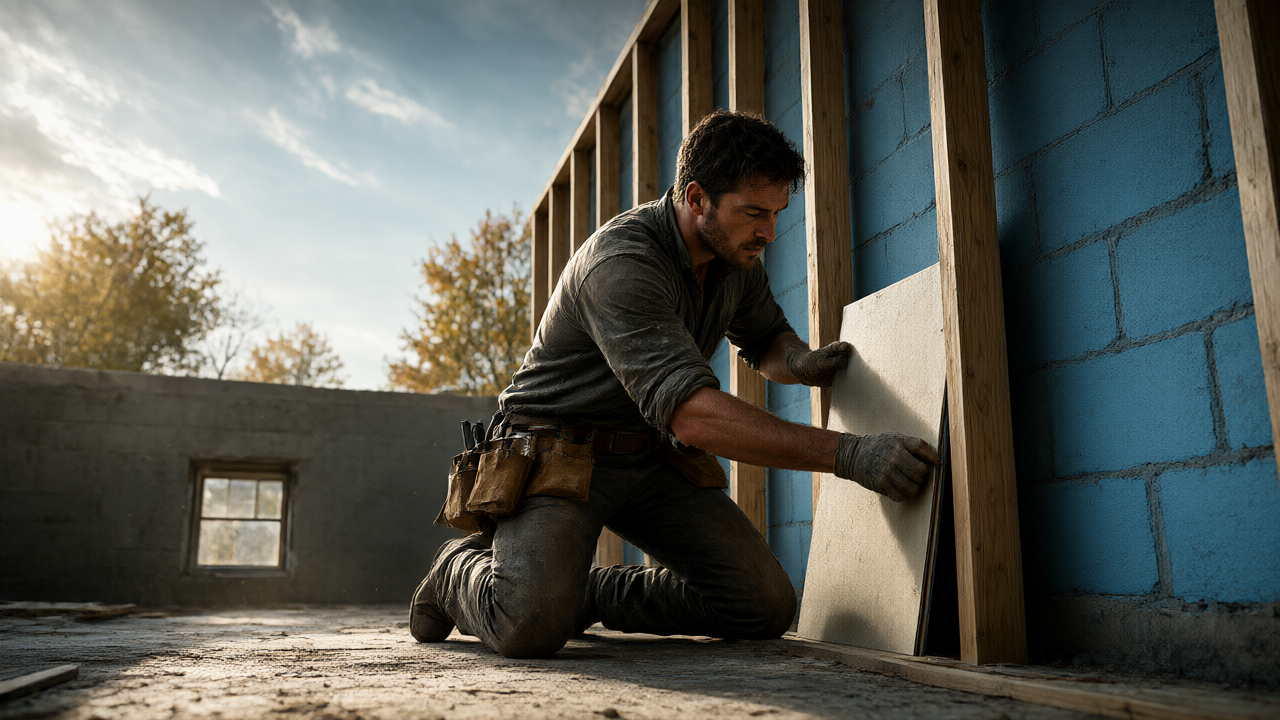
Mistake 1: Skipping a Vapor Barrier Before Framing Your Basement Walls
The vapor barrier isn't optional, and it isn't a sheet of plastic stapled to the studs after framing. The right approach in Waukegan is closed cell spray foam or rigid XPS foam board applied directly to the concrete before any wood goes up. This creates a continuous thermal and vapor break. A 2 inch layer of closed cell foam delivers an R value around 13 and stops nearly all moisture vapor transmission.
What goes wrong when crews skip it: fiberglass batts sit against the cold concrete, moisture condenses inside the batt, and the batt loses most of its R value. The wood studs stay damp. Within 18 to 24 months you've got rot at the bottom plate and mold on the back of the drywall. The homeowner never sees it until the smell gives it away.
What to check before your contractor frames anything:
- Is the concrete wall clean, dry, and free of efflorescence (the white powdery stuff)?
- Is there a continuous rigid foam or spray foam layer with taped seams, or just bare studs against block?
- Is the bottom plate pressure treated lumber sitting on a sill gasket, not directly on concrete?
- Are there gaps of at least 1 inch between the foam and any interior framing to allow drying?
If the answer to any of those is no, stop the job. Fixing it after drywall goes up costs three times as much as doing it right the first time.
Mistake 2: Choosing Flooring That Traps Moisture in Waukegan Basements
Flooring is where Waukegan homeowners get talked into the wrong product by well meaning salespeople. Carpet over a concrete slab feels warm and looks great in the showroom. In a lakefront basement, it's a sponge. Moisture wicks up through the slab, the carpet backing traps it, and the pad becomes a mold farm. Most basement carpet failures we see trace back to slab moisture that was never tested.
The fix starts with a calcium chloride test or a plastic sheet test before any flooring decision. Tape a 2 foot square of plastic to the slab for 24 hours. If condensation forms underneath, you have a moisture problem that needs a vapor barrier or a subfloor system before anything goes down. For finished basements along the lake, luxury vinyl plank or Vinyl Flooring over a dimpled subfloor membrane is the safest bet. These products tolerate occasional dampness, don't support mold growth, and can be replaced in sections if a pipe bursts. Burns Carpentry installs both vinyl flooring and Laminate Flooring throughout the Waukegan area, and the crew will tell you straight up if your slab isn't ready for either.
Budget expectations for a 500 square foot basement floor in 2026: $2,500 to $5,500 installed for quality vinyl plank, plus $1,200 to $2,800 if a subfloor membrane system is needed. Carpet might save you $800 upfront and cost you $6,000 in remediation later.

Mistake 3: Ignoring Foundation Wall Cracks and Seepage Before Finishing
Every Waukegan basement has cracks. Hairline shrinkage cracks in poured concrete are normal. What's not normal is water staining, white efflorescence, or a damp ring at the base of the wall. Those are signs of active seepage that will get worse once you finish the space and trap moisture behind drywall.
Before any finishing work begins, walk the entire perimeter and check for:
- Vertical or diagonal cracks wider than 1/8 inch, which usually need epoxy or polyurethane injection ($400 to $900 per crack)
- White powder or crust on the block, indicating moisture moving through the masonry
- Rust stains or damp spots near the floor line, which point to hydrostatic pressure from the water table
- Musty odor even in dry weather, which means moisture is already present
Exterior grading matters too. The ground around a Waukegan home should slope away from the foundation at roughly 6 inches over the first 10 feet. Downspouts should discharge at least 6 feet from the wall. Those two fixes alone solve a surprising number of seepage problems for a few hundred dollars. If the seepage is coming through the wall itself, interior drain tile and a sump system typically runs $3,000 to $7,000 installed, and it's money well spent before you frame a single wall.
Mistake 4: Poor Ventilation and HVAC Design That Traps Humid Air
A finished basement needs its own air strategy. Too many Waukegan basements get one supply vent off the main furnace and no return, which pressurizes the space and pushes moist air into wall cavities. The result is condensation on cool surfaces and a basement that smells like a gym bag by July.
The right setup: a dedicated return air path, a supply register sized for the square footage (roughly 1 CFM per square foot), and a dehumidifier rated for the space. For a 700 square foot finished basement, a 50 to 70 pint dehumidifier running seasonally will keep relative humidity between 45% and 55%, which is the range that stops mold growth. Expect to spend $250 to $500 on the unit and $30 to $60 per month in electricity during the humid season.
Bathrooms and laundry areas need dedicated exhaust fans vented to the exterior, not into the joist cavity. If your contractor vents a basement bathroom fan into the floor structure above, that's a red flag. It's a code violation in most Illinois jurisdictions and it dumps moisture exactly where you don't want it.
Mistake 5: Using Standard Drywall Instead of Moisture-Resistant Materials Near the Lake
Standard 1/2 inch drywall is fine for above grade interior walls. In a Waukegan basement, it's a liability. Moisture resistant (MR) drywall costs about 15% to 20% more, roughly $14 to $18 per sheet versus $11 to $14 for standard, and it buys you time when humidity spikes. Better yet, use paperless drywall in areas within 4 feet of the foundation wall or below grade slab.
For the first 4 feet up from the floor, consider cement board or fiberglass mat drywall rather than paper faced product. Paper is food for mold. The cost difference for a typical 700 square foot basement runs $400 to $800 in materials, which is cheap insurance compared with tearing out a wall in three years.
Finishing details matter too. Use mold resistant primer and paint on all surfaces, and leave a 1/2 inch gap between the drywall and the floor slab. That gap is hidden by baseboard but gives any incidental water a place to escape rather than wick up into the wall.
One honest note: if your basement has active water intrusion, no amount of moisture resistant material solves it. Fix the water first. If a contractor tells you they can finish the basement and address the seepage later, find another contractor.
Frequently Asked Questions
How much does basement finishing cost in Waukegan in 2026?
Most Waukegan basement finishing projects run $45 to $85 per square foot for a full build out, which puts a 700 square foot basement between $31,500 and $59,500. Moisture control measures like foam insulation, subfloor membranes, and dehumidification add roughly 8% to 12% to that total, but they're the difference between a basement that lasts and one that needs remediation.
Do I need a permit to finish my basement in Waukegan?
Yes. The City of Waukegan requires permits for basement finishing that includes framing, electrical, plumbing, or HVAC work. Burns Carpentry handles the permit application process with the city as part of every basement finishing and Basement Remodeling project, which keeps the inspection schedule on track and avoids surprises at resale.
How long does a basement finishing project take?
A typical 700 to 900 square foot basement takes 6 to 10 weeks from permit approval to final inspection, depending on scope and inspection scheduling. Moisture remediation, if needed, adds 1 to 2 weeks at the front end. Plan for the space to be unusable during construction, and expect daily dust control measures to be part of the job.
Can I finish my basement myself to save money?
Some homeowners handle demolition, painting, and trim work, which can save 10% to 15% of the total cost. But moisture control, framing, electrical, and HVAC are where DIY basements fail inspections and create long term problems. If you're not confident reading a moisture meter and detailing a vapor barrier, hire that portion out. It's the part that's hardest to fix later.
If you're planning a Waukegan basement project and want a straight answer about what your space actually needs, Burns Carpentry handles basement finishing and basement remodeling across Waukegan and the surrounding Illinois communities. Andy Burns and the crew will walk your basement, test for moisture, and tell you honestly whether you're ready to finish or whether the water needs to be addressed first. That conversation costs nothing, and it's the one that saves Waukegan homeowners the most money.