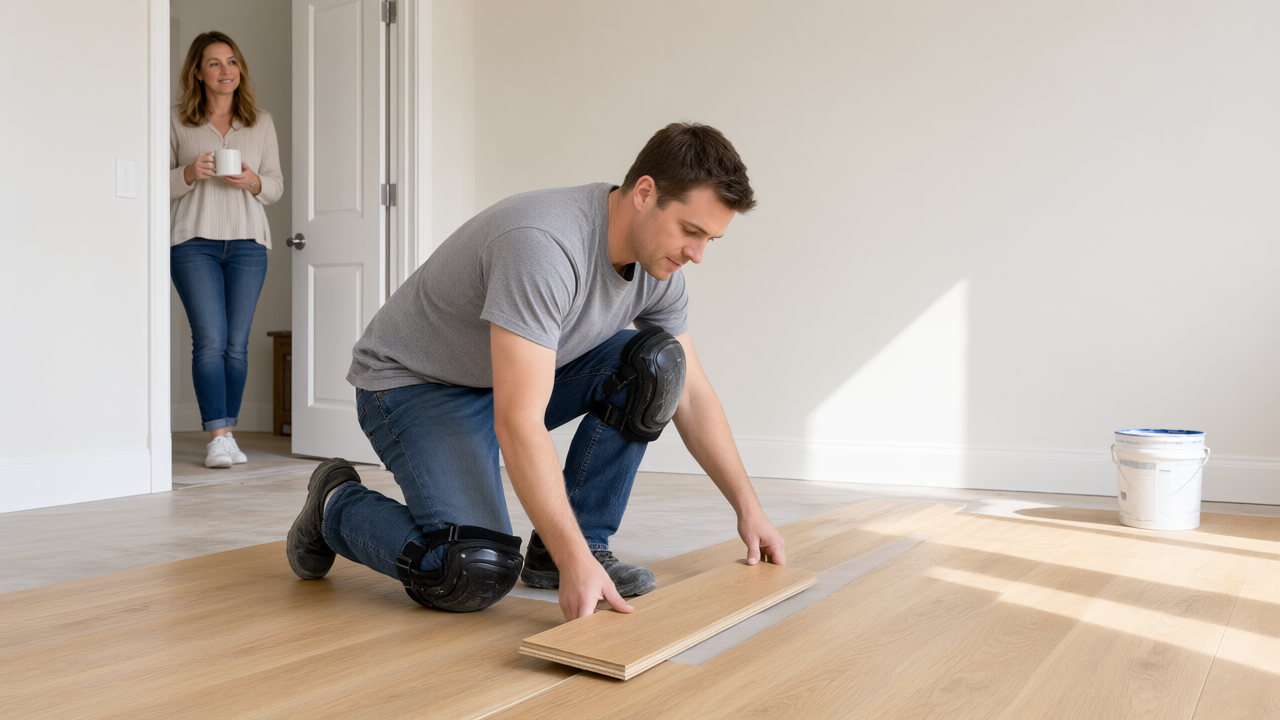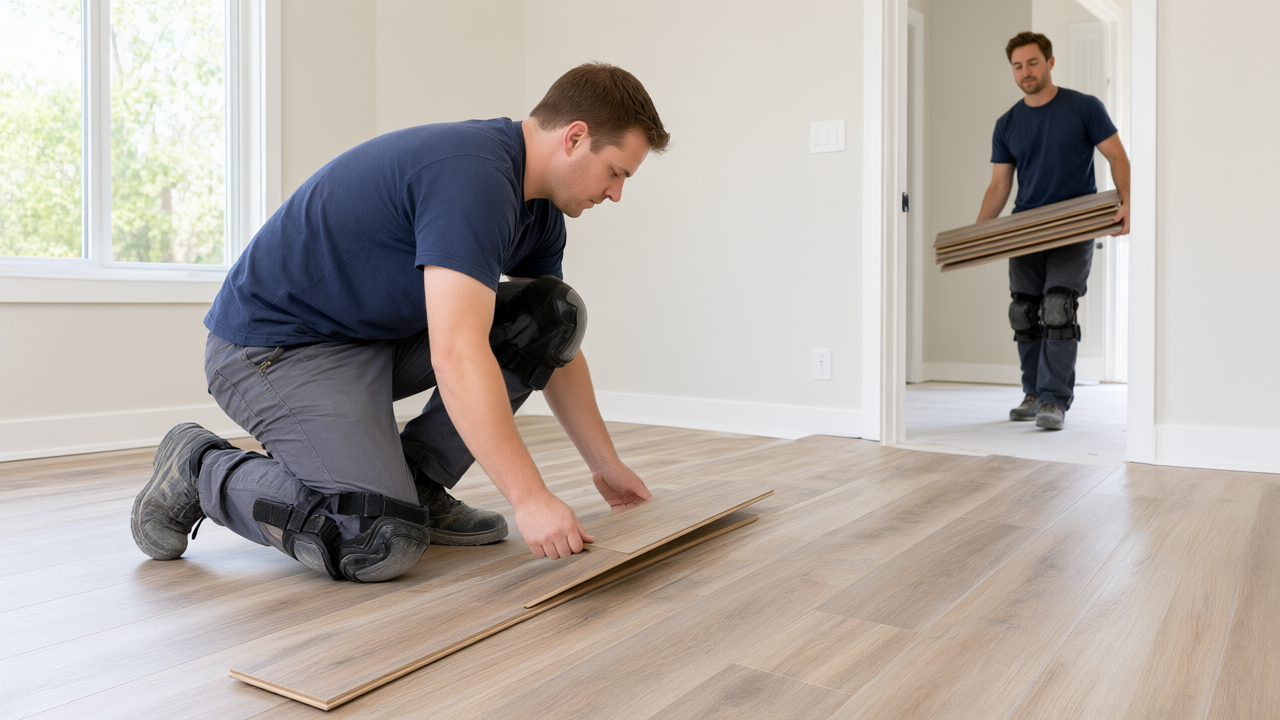
Flooring installation in Cary, IL almost always costs more than the estimate, and it's rarely because of labor. It's because of waste. The average flooring project loses 10% to 15% of purchased material to offcuts, mis cuts, and overordering, and at $4 to $8 per square foot for mid grade laminate or vinyl, that's $400 to $1,200 quietly added to a 1,000 square foot job. The good news: most of that loss is preventable before a single plank comes out of the box.
Burns Carpentry installs flooring across Cary and the surrounding McHenry County area, and we've seen the same waste patterns repeat on job after job. Some come from how the material was ordered. Some come from the layout. Some come from homeowners buying 20% extra "just in case" and then eating the return shipping when the retailer won't take it back. Here's what actually drives waste, and how to cut it without cutting corners.
How Much Flooring Material Gets Wasted During Installation in Cary, IL Homes
Industry data puts average flooring waste at 5% for a simple rectangular room with a straight lay and up to 20% for a diagonal or herringbone pattern with multiple closets and doorways. The gap between those two numbers is the single biggest lever on your material cost, and it has nothing to do with the quality of the flooring you buy.
Where does the waste actually come from? In a typical Cary ranch or two story with a standard layout, roughly half the waste is unavoidable. Every cut along a wall produces an offcut that can't be reused because it's too short to span the next row. Board ends need to be staggered at least 6 inches, sometimes more, and that stagger eats material. Doorways, thresholds, and angled walls all force cuts that can't be repurposed. That's the 5% to 8% you should expect and budget for.
The other half is where money gets burned. We routinely see these in Cary homes:
- Wrong order quantity. Homeowners buy by room instead of by total square footage, then come up short and pay a second delivery fee or a premium for a partial box.
- Mismatched dye lots. Buying from two different pallets or production runs, then discovering the color is slightly off and reordering a full new batch.
- Bad layout planning. Starting the first row against the most visible wall instead of centering the pattern, which forces a narrow rip cut on the opposite wall and wastes a full row.
- Damage during storage. Boxes stacked in a damp Cary garage in October absorb moisture, warp at the edges, and get pitched before installation even starts.
- Overcutting on the miter saw. This one is almost entirely a DIY problem, but it's real. An experienced installer cuts within 1/16 of an inch on the first pass. A first timer often cuts twice.
That last point matters more than people expect. A single extra cut per row across a 40 row room adds up to dozens of wasted linear feet, and it's the same reason professional installation tends to use less material than a weekend project even when the square footage is identical.

5 Planning Techniques That Reduce Flooring Waste and Lower Your 2026 Project Cost
None of these require special tools. They require doing the math before you buy, and being honest about which pattern you actually want versus which pattern fits your budget.
1. Measure by total square footage, not by room
Add every room, closet, hallway, and transition strip into one number, then add your waste factor. Don't round up room by room, because you'll double count the overlaps and end up with three extra boxes. A 1,000 square foot home with a straightforward layout needs about 1,050 to 1,080 square feet of material, not 1,200.
2. Pick your pattern before you pick your quantity
Straight lay with the planks running parallel to the longest wall is the most efficient. Diagonal and herringbone look great and cost more, sometimes significantly more. In a Cary living room, a diagonal layout can push waste from 7% to 15% on its own. If the budget is tight, straight lay gets you 90% of the visual impact for half the waste.
3. Buy all material at once from the same lot
Dye lot consistency is not a marketing gimmick. Laminate and vinyl plank color varies by production run, and mixing lots is the fastest way to a floor that looks patchy under natural light. Order everything in one transaction, verify the lot numbers match on every box, and store the extras in a climate controlled space until installation day.
4. Plan the layout from the center of the most visible room
Snap a chalk line down the center of the room the eye lands on first, usually the living room or main hallway, and work outward. This keeps full planks in the middle and pushes the narrow rip cuts to the edges where furniture and baseboards hide them. It also reduces the number of awkward cuts you'll need to make at the walls.
5. Keep a labeled offcut pile for future repairs
Every project generates usable offcuts, usually 3% to 5% of the total. Box them up, label the lot number and install date, and store them. When a plank gets damaged three years from now, you'll have a matching piece instead of a discontinued product problem. This single habit has saved Burns Carpentry clients thousands over the life of their floors.
Where to Buy Flooring in Cary, IL to Avoid Overordering and Returns
The Cary area has a decent mix of options: big box stores along Route 14, specialty flooring retailers in Crystal Lake and Algonquin, and online sellers that ship direct. Each has a different return policy, and the return policy is where the real money hides.
Big box stores typically accept returns on unopened boxes within 30 to 90 days, but they rarely accept returns on opened boxes, and they almost never accept returns on cut material. That means the 10% you overbought is only refundable if you never opened it. Specialty retailers are often more flexible, sometimes accepting opened boxes with a restocking fee of 15% to 25%. Online sellers are the worst of the three, with return shipping often costing $80 to $200 per pallet and restocking fees that can wipe out any savings from the lower sticker price.
Here's the practical rule: buy 5% to 10% overage for a straight lay, 10% to 15% for diagonal, and 15% to 20% for herringbone or complex layouts. Buy from a seller that's within driving distance so a return trip is a 20 minute errand instead of a freight shipment. And confirm the return policy in writing before you swipe the card, because the difference between "unopened only" and "opened with 15% restocking" can be $300 on a mid size project.
If a seller won't put the return policy in writing, that's your answer. Walk out.

How Professional Installation Minimizes Waste Compared to DIY Flooring Projects
DIY flooring is a legitimate option for a small, simple room. If you're doing a single 12 by 14 bedroom with a straight lay and you own a miter saw, a tapping block, and a pull bar, you can absolutely handle it. We'll tell you that straight up. What we won't tell you is that you'll use the same amount of material as a pro, because you won't.
Experienced installers bring three waste reducing advantages that are hard to replicate on a first project. First, layout planning. We measure and dry fit the first two rows before committing, which catches centering problems before they cost material. Second, cut accuracy. A pro cuts within 1/16 of an inch on the first pass and knows how to reuse offcuts across rooms. Third, sequencing. We install in an order that lets leftover pieces from one room feed the next, which typically recovers 3% to 5% of what a DIY project would throw away.
The other advantage is climate handling. Cary winters swing from 20 degree nights to 40 degree days, and laminate and vinyl both need to acclimate in the room where they'll be installed for 48 to 72 hours before installation. Skip that step and the planks expand or contract after install, causing gaps and buckling that no amount of material savings will fix. Burns Carpentry builds acclimation time into every project schedule so the floor performs the way it's supposed to for the next 15 to 20 years.
Real Savings: What Cutting Waste Means for Your Cary, IL Flooring Budget
Run the numbers on a typical 1,000 square foot Cary flooring project. Mid grade laminate runs $3.50 to $6.00 per square foot installed. Vinyl plank runs $4.00 to $8.00 installed. Say you're looking at $5.00 per square foot, which puts the base material and labor at $5,000.
If you overbuy by 20% instead of 10%, you're paying for 100 extra square feet, or $500 in material that may or may not be returnable. If you pick a diagonal layout on a room that didn't need one, add another $150 to $300 in waste. If you reorder mid project because the first batch was short, add a second delivery fee of $75 to $150 plus the risk of a mismatched dye lot. Stack those up and the difference between a well planned project and a poorly planned one is easily $800 to $1,200 on a job this size.
That's the same money you could put toward upgrading from laminate to vinyl plank, adding a moisture barrier in a basement, or extending the flooring into a closet you were going to skip. Waste reduction isn't about spending less on flooring. It's about spending the same amount and getting a better floor out of it.
Frequently Asked Questions
How much extra flooring should I buy for a Cary, IL installation?
Plan on 5% to 10% overage for a straight lay, 10% to 15% for diagonal, and 15% to 20% for herringbone or rooms with lots of doorways and closets. Buy it all in one transaction from the same lot so the color matches, and keep the offcuts for future repairs.
How long does a Flooring Installation take in Cary, IL?
Most projects take two to five days depending on square footage and layout complexity. Add 48 to 72 hours before installation for acclimation. Burns Carpentry schedules the work so most of your home stays usable throughout, and we'll walk you through the daily plan before we start.
Is it cheaper to install flooring myself or hire a professional in Cary?
For one small room with a straight lay, DIY can save money if you already own the tools. For anything over 500 square feet, multiple rooms, or a diagonal pattern, professional installation usually costs about the same after you factor in tool rental, waste from miscuts, and the risk of a redo. Get a free estimate before you decide. It's the fastest way to know which side of the line your project falls on.
Do I need to move my furniture before flooring installation?
Yes, and it's the one prep step homeowners most often underestimate. Clear the rooms completely, including closets, and remove wall hangings from adjacent rooms since installers use tapping blocks and mallets. Burns Carpentry can help coordinate furniture moving for larger projects, but for a single room, having it cleared before the crew arrives saves you half a day of labor cost.
If you're planning a flooring project in Cary and you want to know exactly how much material you actually need, Burns Carpentry will measure it for free and give you a straight answer on whether it's a DIY job or a professional one. Call Andy Burns and the team, ask about Laminate Flooring and Vinyl Flooring installation, and get a real number before you buy a single box.