If you live in Cary, Illinois, you already know the drill. April through June, every flat surface in your house wears a thin yellow coat of tree pollen. Then July hits with 80% humidity that hangs around like a houseguest who won't leave. For the roughly 1 in 4 adults in McHenry County who deal with seasonal allergies or asthma, your floors are either your first line of defense or the thing quietly working against you every single day. Choosing the right Flooring Installation for a Cary home with allergies in 2026 isn't about picking the prettiest plank. It's about picking a surface that doesn't trap pollen, doesn't feed mold, and doesn't off-gas chemicals into the air your family breathes.
Why Cary's Seasonal Pollen and Humidity Make Flooring Choice Matter for Allergy Sufferers
Cary sits in a pocket of northern Illinois where the tree canopy is thick and the summer air is heavy. Oak, maple, and cottonwood dump pollen from late March into June. Then the humidity climbs and stays. Basements in this area, including the finished ones, routinely run 55% to 65% relative humidity without a dehumidifier, and that is prime territory for mold and dust mites.
Here is the part most homeowners miss: your flooring is a reservoir. Carpet fibers grab pollen, pet dander, and dust mite waste and hold onto them. Every time you walk across a carpeted room, you kick a fine cloud of those particles back into the air. A 2024 indoor air study found that carpeted rooms held roughly 100 times more allergen particles per square foot than hard surface floors in the same home. If someone in your house wakes up congested every morning, the carpet in the bedroom is often the culprit, not the pollen outside.
Hard surfaces do not hold allergens. They let you remove them with a damp mop or a vacuum. That single mechanical difference is why the flooring conversation changes completely for an allergy household. It is not about style. It is about what you can actually clean.
One honest note before you spend a dollar: if your allergies are mild and your carpet is new, you may not need to rip anything out. Try a HEPA vacuum twice a week and a dehumidifier set to 45% to 50% for a season. If symptoms improve, save your money. If they do not, flooring is a legitimate next step.

Ranking Flooring Types by Allergen Resistance: Vinyl, Laminate, and More
Not all hard flooring performs the same in an allergy household. The differences come down to surface texture, seam count, and how much volatile organic compound (VOC) the material releases when it is new. Here is how the common options stack up for a Cary home.
Luxury vinyl plank (LVP) is the top pick for most allergy households. Burns Carpentry installs Vinyl Flooring with tight interlocking seams and a smooth or lightly embossed surface that does not trap particles. Quality LVP carries a low VOC profile and stands up to the moisture swings this region throws at a house. Expect $4 to $9 per square foot installed in the Cary area, depending on thickness and wear layer.
Laminate flooring is a strong second. It is hard, it cleans easily, and it costs less than most hardwood. The catch is the core. Older or bargain laminate can off-gas formaldehyde for weeks. Look for laminate labeled CARB Phase 2 compliant or Greenguard Gold certified, and let it acclimate in your garage or a spare room for 48 to 72 hours before installation. Burns Carpentry handles Laminate Flooring installation with that acclimation step built into the schedule, not skipped.
Tile and stone are the gold standard for allergen resistance because they are inert and hold nothing. They are also cold underfoot and harder on the budget, often $12 to $25 per square foot installed. A good compromise is tile in bathrooms, kitchens, and basements with LVP or laminate everywhere else.
Hardwood is beautiful and generally fine for allergies, but it moves with humidity and needs a stable indoor range of 35% to 55% relative humidity to avoid gapping. It also costs the most, typically $8 to $15 per square foot installed in this market.
Carpet is the one to avoid in bedrooms and living spaces if allergies are the driver. If you cannot give it up entirely, keep it out of the rooms where you sleep and spend the most time.
- Best overall: Luxury vinyl plank, low VOC, moisture tolerant, easy to clean
- Best value: Greenguard certified laminate with 48 to 72 hour acclimation
- Best for wet areas: Porcelain tile, inert and allergen free
- Best long term investment: Solid hardwood, if humidity stays controlled
- Avoid in allergy bedrooms: Wall to wall carpet of any fiber type
Installation Methods That Minimize Dust and VOC Exposure During Your Cary Project
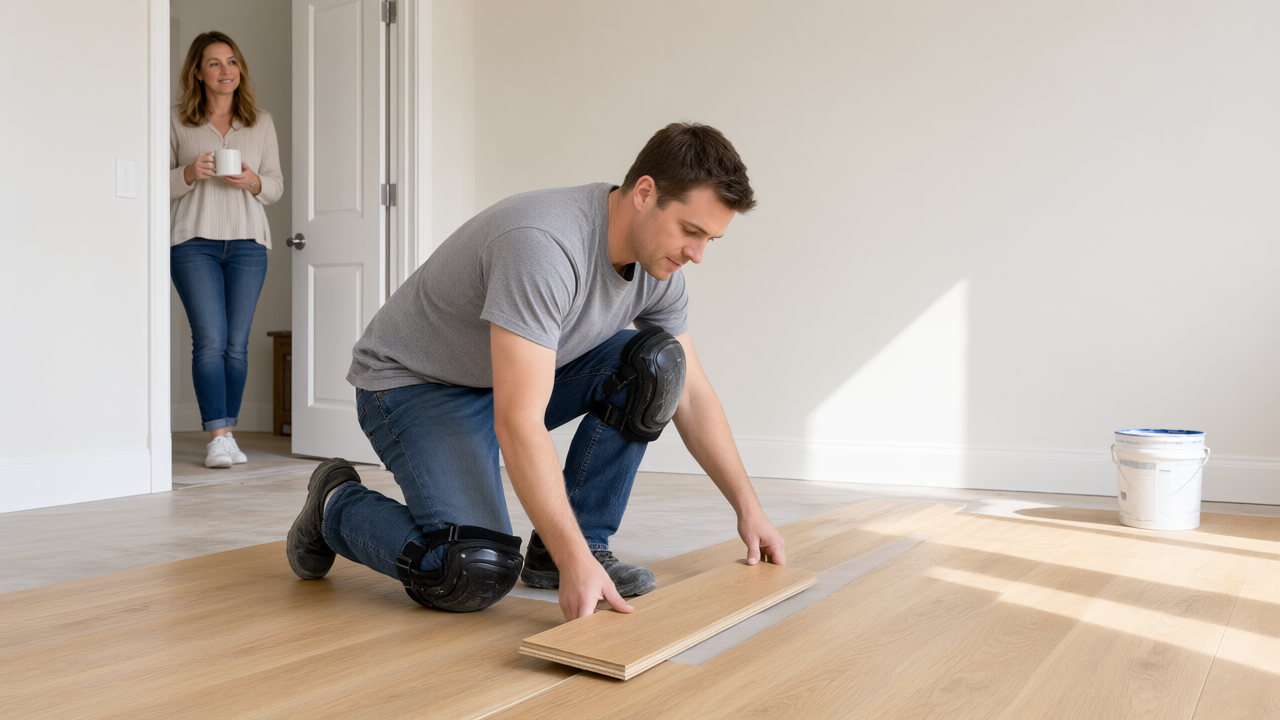
The flooring you pick matters. How it gets installed matters almost as much, because a sloppy install throws fine dust and adhesive fumes through your whole house. A typical flooring installation in Cary takes two to five days depending on square footage and material, and a good crew plans the dust control before the first box is opened.
Two installation methods dominate. Floating floors click together over an underlayment with no adhesive at all. That means zero glue fumes, which is a big deal for anyone sensitive to VOCs. Glue down and nail down installs use adhesive or fasteners and tend to feel more solid underfoot, but they require low VOC adhesive and careful ventilation. For an allergy household, floating vinyl or laminate is usually the lower risk choice.
Here is the dust and VOC game plan Burns Carpentry follows on allergy sensitive jobs, and it is the same checklist you should ask any installer about before you hire them:
- Seal the work zone. Plastic sheeting over doorways and HVAC returns keeps demolition dust out of the rest of the house.
- Run a HEPA air scrubber in the room during tear out and installation.
- Remove old carpet carefully. Cut it into manageable sections, bag it, and carry it out without dragging it through the house.
- Choose low VOC adhesive or go with a floating floor to skip adhesive altogether.
- Ventilate for 48 to 72 hours after the job, and change your HVAC filter the day the crew leaves.
- Wipe down surfaces once the dust settles, using a damp cloth, not a dry one that just moves particles around.
One red flag to watch for: any installer who tells you dust control is not necessary, or who wants to cut carpet in place with a utility knife and haul it out through your living room. That is how a two day job turns into two weeks of coughing. Ask specifically how they plan to contain dust, and if the answer is vague, keep looking.
Burns Carpentry is licensed and insured for work across Cary and McHenry County, and the crew will walk you through the dust control plan during your free estimate. The estimate process starts with a visit to your home, a measurement of the space, and a conversation about your allergy concerns, not a generic quote over the phone.

5 Post-Installation Habits That Keep Your New Floors Allergy-Friendly Year-Round
New floors do not stay allergen free on their own. A few simple habits keep them working for your lungs all year, through every Illinois season.
First, vacuum with a HEPA filter, not a broom. Sweeping just lifts dust into the air. A HEPA vacuum captures particles down to 0.3 microns, which includes most pollen and dust mite debris. Twice a week is enough in most rooms.
Second, damp mop once a week. A microfiber mop with a little water does more for indoor air than any air purifier. Dry mopping or dusting just redistributes the problem.
Third, control humidity. Keep indoor relative humidity between 40% and 50%. In Cary, that usually means a dehumidifier in the basement from May through September and a whole home humidifier running in January and February when the furnace dries everything out.
Fourth, use entry mats and a no shoes rule. Most pollen and outdoor dust enters on feet. A good mat at every door and a shoes off habit cuts tracked in allergens dramatically.
Fifth, change your HVAC filter on schedule. Every 60 to 90 days, more often during pollen season. This is the cheapest allergy improvement in your house, and it protects the investment you just made in new floors.
Frequently Asked Questions
How much does flooring installation cost in Cary, IL?
Most Cary homeowners pay between $4 and $9 per square foot installed for vinyl or laminate, and $8 to $25 per square foot for hardwood or tile. A typical 500 square foot project lands somewhere between $2,500 and $6,000. Get a free estimate with exact measurements before you commit.
What is the best flooring for allergies and asthma?
Luxury vinyl plank is the best all around choice for most allergy households. It has tight seams, low VOC emissions, handles humidity well, and cleans with a damp mop. Tile is even better for allergen resistance but costs more and feels colder.
Do I need to move out of my house during flooring installation?
No, you can stay home. A typical installation takes two to five days, and the crew works room by room so most of your house stays usable. If you are sensitive to adhesive fumes, choose a floating floor and ventilate well for the first 48 to 72 hours.
How do I know if I need a professional or can DIY my flooring?
If you are doing a single small room over a flat, dry subfloor, a floating floor is a reasonable DIY project. Call a professional for anything over 300 square feet, any room with moisture issues, or any install that requires subfloor leveling. Bad subfloor prep is the number one reason new floors fail early, and fixing it after the fact costs more than hiring it done right the first time.
If your Cary home needs new floors and allergies are part of the reason, Burns Carpentry handles flooring installation, vinyl flooring, and laminate flooring across Cary and the surrounding Illinois communities. Andy Burns and the crew will look at your space, talk honestly about what you actually need, and tell you straight if the job is something you can handle yourself. Call for a free estimate and get a dust control plan in writing before anyone lifts a pry bar.