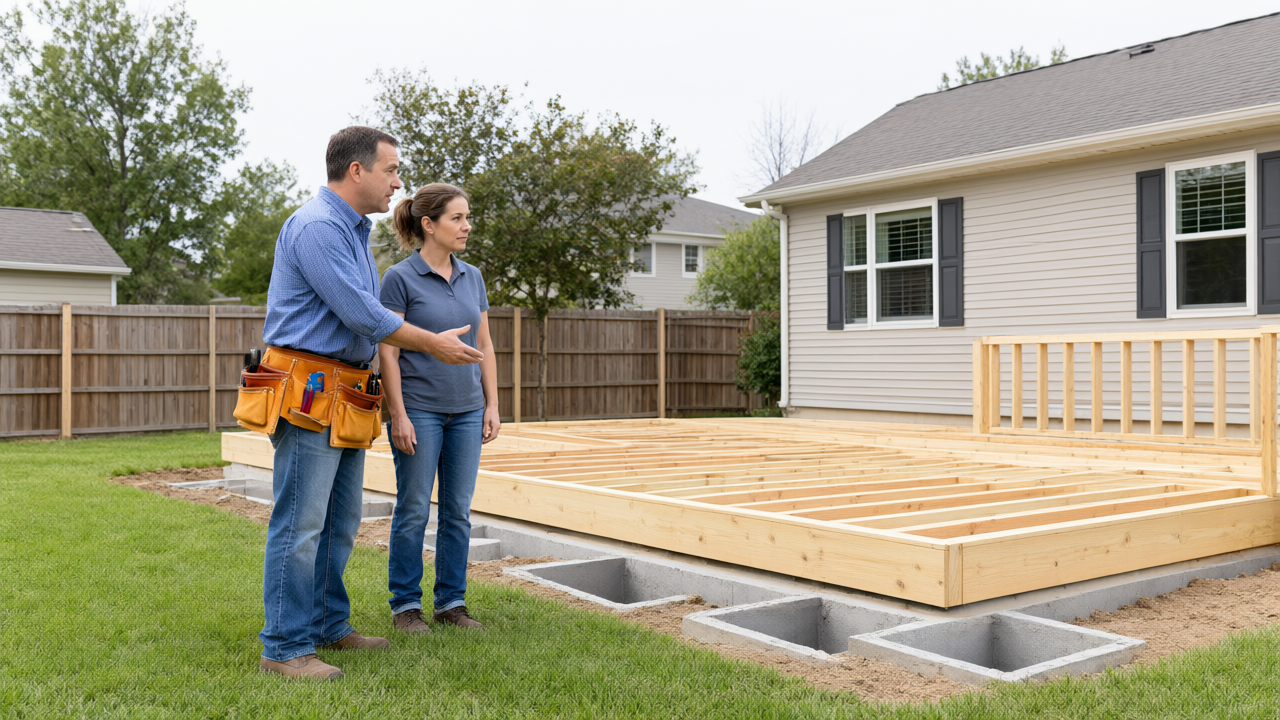
Last spring, a homeowner in Arlington Heights watched a crew of three men build a 16 by 20 foot deck behind her house in four days. No permit. No visible insurance certificate. No written contract. She paid $18,400 in cash. Six weeks later, a joist hanger failed, the ledger board pulled away from the rim joist by nearly two inches, and the deck was condemned by the village inspector. That's when she found out the contractor's phone number was disconnected and the "business" had never been registered with the State of Illinois. She spent $31,000 to tear out the deck and rebuild it properly. Deck building in Arlington Heights is one of the highest-risk home improvement categories in the country for exactly this reason: the work looks simple enough that anyone with a circular saw and a truck can sell it, and the consequences of hiring the wrong person don't show up for months.
This guide is written for homeowners who want to do this right the first time. You'll learn exactly what credentials an Illinois deck contractor must carry in 2026, how to verify them in under ten minutes without making a single phone call, and the five specific warning signs that separate a legitimate builder from a guy who's hoping you won't ask questions.
Why Arlington Heights Homeowners Get Burned by Unlicensed Deck Contractors
Cook County has no countywide contractor licensing requirement for residential deck construction. That single fact is the root of most of the problems in this market. The State of Illinois regulates certain trades (plumbing, electrical, roofing in some municipalities), but general carpentry and Deck Building fall into a regulatory gap that individual municipalities fill, or don't, on their own terms. Arlington Heights does require building permits for decks over 30 inches above grade and for any deck attached to a dwelling, but a permit is a property approval, not a contractor verification. The village checks that the plans meet code. It does not check that the person holding the hammer carries liability insurance or has a registered business entity.
What this means in practice is that the deck building market in Arlington Heights includes everyone from established builders with $2 million in general liability coverage down to uninsured handymen operating entirely in cash. The pricing gap between those two ends of the spectrum is real and it's tempting: an unlicensed crew will typically quote 30 to 45 percent less than a licensed and insured builder for the same square footage. On a 320 square foot composite deck, that's the difference between roughly $22,000 and roughly $32,000. The problem is that the low bid is only low because someone else is carrying the risk. That someone is you.
Homeowners get burned because they ask the wrong question. They ask "How much?" before they ask "Are you insured?" and "Can I see your certificate of insurance?" Those are not the same conversation, and the second one is the one that protects your house, your savings, and your relationship with your neighbor whose kid is going to be standing on that deck at a barbecue next summer.

Illinois Licensing & Registration: What a Legitimate Deck Builder Must Carry in 2026
Here's the part most homeowners never hear clearly explained. Illinois does not issue a statewide "deck builder license." Anyone who tells you they have one is either confused or lying. What a legitimate deck building company in Arlington Heights actually carries is a stack of separate credentials, and each one covers a different failure mode.
First, a registered business entity. Every legitimate contractor is either a corporation, an LLC, or a sole proprietorship registered with the Illinois Secretary of State. You can look this up for free at the Secretary of State's business search. If the company name on the estimate doesn't return a result, stop there. That's not a technicality. An unregistered entity can't be sued in its business name, which means your legal recourse if something goes wrong evaporates.
Second, general liability insurance. This is the policy that pays if the crew drops a bundle of composite boards through your sliding glass door or damages your neighbor's fence. A serious deck builder in the Chicago suburbs carries at least $1 million per occurrence and $2 million aggregate. Ask for a certificate of insurance (COI) and read the effective dates, not just the coverage limits. A COI that expired last month is worthless.
Third, workers' compensation insurance. This is the one homeowners skip, and it's the most expensive mistake. If a crew member falls off your half-built deck and the builder doesn't have workers' comp, that worker's medical bills and lost wages can come after you as the property owner. Illinois takes this seriously. Ask for the workers' comp carrier name and policy number, then verify it directly with the carrier.
Fourth, a surety bond. Not every deck builder carries one, but the good ones do. A $10,000 to $25,000 surety bond is your backstop if the contractor takes a deposit and disappears. It's cheap for the builder (usually $100 to $300 per year) and it tells you they've been vetted by a bonding company.
Fifth, local registration where required. Arlington Heights does not currently require a separate contractor registration for deck work, but several surrounding suburbs do, including parts of the service areas in Palatine and Schaumburg. If your builder works across multiple towns, ask which municipal registrations they hold. A builder who can't answer that question has never been asked before, which tells you something.
How to Verify a Contractor's License, Insurance, and Bond in Under 10 Minutes
You don't need to hire anyone to do this. Set a timer for ten minutes and work through these steps in order. If a builder fails at any step, you don't need to complete the rest.
- Search the Illinois Secretary of State business database (2 minutes). Go to the Secretary of State website, enter the company name exactly as it appears on your estimate, and confirm the entity is "Active" and in "Good Standing." Note the registered agent's name. If it doesn't match the person signing your contract, ask why.
- Request the certificate of insurance by email, not text (2 minutes). A legitimate builder can email a COI within an hour. Ask for the general liability certificate and the workers' compensation certificate separately. If they say "I'll bring it the day we start," that's a no.
- Call the insurance carrier directly (3 minutes). The phone number is on the COI. Call it and ask two questions: "Is this policy active?" and "Is [company name] covered for residential deck construction?" Some policies exclude certain work categories. The carrier will tell you straight.
- Verify the surety bond if they claim one (1 minute). Call the bonding company listed on the bond certificate and confirm the bond is active and the dollar amount. A $5,000 bond on a $30,000 deck is a red flag, not a green light.
- Check the permit history (2 minutes). Call Arlington Heights Building & Zoning and ask whether the contractor has pulled permits in the village under their business name in the last 12 months. A builder who has never pulled a permit is either brand new or avoiding them.
Total time: about ten minutes. That ten minutes is the difference between a deck you enjoy for 20 years and a deck that costs you $30,000 twice. Burns Carpentry keeps current certificates of insurance, a registered Illinois business entity, and a surety bond on file, and any homeowner can request copies before signing anything. That's not a sales pitch. That's the baseline every deck builder should meet.

5 Red Flags That Signal a Deck Builder Isn't Properly Insured in Arlington Heights
You won't always get a straight answer when you ask about insurance, so learn to read the signals. These five patterns show up again and again in the complaints filed with the Illinois Attorney General's office and in the stories homeowners tell after a bad deck build.
- They ask for a large cash deposit up front. A legitimate builder typically asks for 10 to 30 percent down, with the balance tied to milestones. If someone wants 50 percent in cash before materials arrive, they're either funding a different job with your money or planning not to finish yours. Cash also leaves no paper trail, which is exactly the point.
- They can't name their insurance carrier. "I've got insurance, don't worry about it" is not an answer. Anyone who carries real coverage knows their carrier's name, the policy number, and the renewal date without checking. If they have to "look it up" and never get back to you, there's no policy.
- The estimate is verbal or handwritten on a generic form. A professional deck builder provides a written proposal that lists materials by name and grade (for example, "Trex Transcend composite in Spiced Rum, 1-inch by 5.5-inch boards"), labor, permit handling, timeline, and payment schedule. If the paperwork is a text message, walk away.
- They discourage you from pulling a permit. The most common line is "You don't need a permit for that, it's under the height limit." Arlington Heights requires permits for decks attached to a dwelling and for any deck over 30 inches above grade, full stop. A builder who tells you to skip the permit is telling you they're not licensed to pass inspection.
- They have no physical business address and no online footprint older than a year. A legitimate deck building company has a shop, a truck with signage, a business phone number (not a cell), and a web presence you can trace back more than 12 months. Andy Burns and the team at Burns Carpentry work out of a real location and can be found by name. If your builder can't be, that's the whole answer.
What Happens If an Uninsured Crew Gets Hurt on Your Arlington Heights Property?
This is the scenario nobody wants to think about, which is exactly why it happens. A 32 year old carpenter falls 9 feet off an unfinished deck frame while setting a rim joist. He breaks his wrist and his pelvis. His medical bills run $180,000. He can't work for eight months. He has no health insurance because the contractor who hired him pays everyone as "1099 subcontractors" and carries no workers' compensation policy.
Under Illinois law, that injured worker can file a claim against the property owner. Your homeowner's insurance policy may or may not cover it, depending on how the claim is framed and what your policy exclusions say. If your insurer denies the claim, you're on the hook personally. Even if they cover it, your premiums will jump, and a $180,000 claim on your record can make your home difficult to insure going forward.
The fix is simple and it costs you nothing. Before any crew sets foot on your property, get a copy of the contractor's certificate of insurance showing general liability and workers' compensation coverage, both currently in force. Verify it with the carrier. Keep a copy in your files alongside the signed contract and the permit. If the builder can't produce it, you don't have a deck project. You have a future lawsuit with a nice view.
Burns Carpentry has built decks across Arlington Heights, Palatine, Schaumburg, and the surrounding suburbs, and every project starts the same way: with proof of insurance in the homeowner's hands before a single board is cut. If you're planning a deck build in 2026 and want a builder who will hand you the paperwork before you ask, reach out and ask Andy Burns for the certificates. Any legitimate deck builder in Arlington Heights will do the same, and any builder who won't has just saved you the trouble of finding out the hard way.
Frequently Asked Questions
Do I need a permit to build a deck in Arlington Heights?
Yes, you need a permit for any deck attached to your home and for any deck more than 30 inches above grade. Burns Carpentry handles the entire permit application with the village on your behalf, which keeps the process moving and ensures the finished deck passes inspection.
How much does a deck cost in Arlington Heights in 2026?
A pressure treated wood deck typically runs $45 to $65 per square foot installed, while Composite Decks run $65 to $95 per square foot. A 16 by 20 foot composite deck, roughly 320 square feet, usually lands between $21,000 and $30,000 depending on railing, stairs, and site conditions.
How do I check if a deck builder is insured in Illinois?
Ask for a certificate of insurance by email, then call the insurance carrier directly using the phone number printed on the certificate. Confirm the policy is active and covers residential deck construction. You can also verify the business entity through the Illinois Secretary of State business search.
What happens if an uninsured worker gets hurt on my property?
The injured worker can file a claim against you as the property owner, and your homeowner's insurance may or may not cover it. To avoid this entirely, verify workers' compensation coverage before work begins and keep a copy of the certificate in your project file.
If you're in Arlington Heights or anywhere in the northwest suburbs and you want a deck builder who will show you the insurance, the bond, and the permit before you sign anything, call Burns Carpentry. Andy Burns and his crew build custom Wood Decks, composite decks, pergolas, and more, and they'll hand you the paperwork before you ask for it. That's how it should work.